



If you manage screens across more than one location, network digital signage makes it possible to update content, control displays and keep brand messaging consistent from one central cloud platform.
If you manage screens across more than one location - whether that is two retail units or two hundred - you already know the problem. Content gets out of date. Staff update the wrong screen. Brand consistency falls apart when each site manages its own messaging. Last-minute updates become a chain of calls, emails and manual checks.
Network digital signage solves this by connecting commercial screens to a central cloud platform, giving your team one place to manage content, scheduling and screen performance.
ScreenMoove tip: the biggest benefit of network digital signage is not just the screen itself. It is the ability to control every display, across every location, from one central dashboard.
What Is Network Digital Signage?
Network digital signage refers to a system of commercial screens that are connected, managed and updated from a central location, typically through cloud-based software.
Rather than each screen running its own content independently, or relying on someone physically plugging in a USB stick, every screen in a networked system communicates with a content management platform. You control what plays, where it plays and when it plays from one place, remotely and in real time.
This applies whether you have three screens in a single restaurant or 300 screens across a national retail chain. The principle is the same: one dashboard, full control.

How a Multi-Site Digital Signage Network Actually Works
Understanding the architecture helps you make better buying decisions. A network digital signage system normally includes four key layers: commercial screens, media players, internet connectivity and a cloud content management system.
1. The screens
At the display end, you have commercial-grade screens. These are not consumer televisions. Commercial displays are built for continuous operation and come with features such as higher brightness ratings, better heat management, portrait and landscape orientation support, and longer warranties.
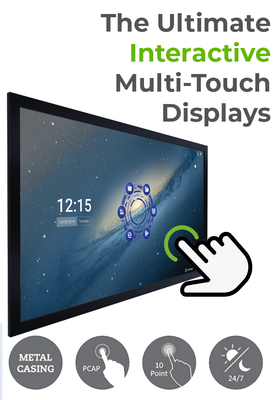
The screens can range from standard commercial digital signage displays to high-brightness window-facing units, video walls or interactive touchscreens, depending on the environment.
2. The media player
Each screen is connected to a media player. This is either a standalone device connected via HDMI or a built-in system-on-chip that sits inside the screen itself.
The media player handles playback, stores content locally for smooth performance and maintains the connection to the cloud platform. If the internet goes down, most quality systems continue playing cached content without interruption.
3. The network connection
Each media player connects to the internet through WiFi, wired ethernet or mobile connectivity. This is how the display stays in sync with the cloud platform, receives new content and reports status back to the dashboard.
For larger deployments, some businesses use 4G or 5G connectivity as a backup or primary connection, particularly in retail environments where network stability is critical.
4. The CMS
The content management system, or CMS, is where everything is controlled. This is the cloud platform you log into to schedule content, assign it to specific screens or groups, monitor device health and manage your display network remotely.

A well-built cloud digital signage CMS lets you:
- Create and schedule content using simple management tools
- Assign content by location, region, screen group or individual display
- Set time-based rules for different messages at different times of day
- Push emergency or last-minute updates across all sites
- Receive alerts if a screen goes offline
- Integrate live data feeds such as social media, pricing, weather or promotions
Why Multi-Site Businesses Choose Cloud Digital Signage
For any business managing screens across multiple sites, the operational advantage of a cloud-based network is significant.
Every screen across every site can show approved, on-brand content managed by one central team.
No USB sticks, manual uploads or site-by-site chasing. Content can be updated remotely in real time.
Different sites can show different promotions, timetables, menus or regional messages while staying on-brand.
Whether you add one screen or one hundred, new devices can be enrolled into the same central system.
In fast-moving environments such as retail, gyms, hospitality and corporate offices, the ability to push content changes quickly is not a nice-to-have. It can directly affect customer experience, staff communication and campaign consistency.
Cloud Digital Signage vs Traditional On-Premise Systems
Older digital signage installations often used on-premise servers. These were physical systems located at a head office or data centre that managed content distribution internally.
Cloud digital signage removes that infrastructure requirement. The platform is hosted remotely, maintained by the provider and accessible through a browser from anywhere.
| Factor | Cloud digital signage | On-premise signage |
|---|---|---|
| Access | Managed remotely through a browser-based dashboard. | Usually managed through local servers or internal infrastructure. |
| Best for | Multi-site businesses, remote teams and scalable screen networks. | Organisations with strict internal IT requirements or closed networks. |
| Setup | Lower infrastructure requirement and faster to deploy. | More technical setup and ongoing server management. |
| Cost model | Usually a monthly or annual software subscription. | Often higher upfront infrastructure cost. |
| Scalability | Easy to add more screens and locations over time. | Scaling may require additional infrastructure planning. |
For most UK businesses today, cloud is the default choice. It reduces the need for internal IT resource, lowers infrastructure complexity and makes remote screen management genuinely practical.
What to Look for in a Network Digital Signage System
Not all digital signage systems are built equally. When evaluating platforms for a multi-site UK deployment, focus on the areas that will affect daily use, scalability and long-term reliability.
Reliability and uptime
The CMS needs to be consistently available. Look for a platform and support partner that can keep your screens running reliably, especially if your displays are customer-facing or business-critical.
Ease of content management
If your team struggles to use the platform, the system fails in practice. The software should make it easy to upload content, build playlists, schedule campaigns and assign content to different locations.
Scalable licensing
Understand how pricing changes as you add more screens or sites. A system that works for five screens should still make sense when your network grows to 50 or 500.
Hardware flexibility
Check whether the platform can work with different screen manufacturers and media player hardware. Too much hardware lock-in can create problems later.
UK-based support
For commercial display networks, fast support matters. If a screen is offline in a retail store, gym or office reception, you need quick guidance and reliable technical help.
Integration capability
Some businesses need signage to connect with POS systems, scheduling tools, pricing feeds, social media, weather data or internal communications platforms. The more connected your signage is, the more useful it becomes.
Real-World Applications Across UK Sectors
Network digital signage is used across a wide range of commercial environments, particularly where businesses need consistent messaging across multiple locations.

Retailers use networked screens for promotions, brand campaigns, window displays and in-store navigation.
Fitness operators can manage class timetables, membership promotions and motivational content across multiple sites.
Hotels, restaurants and venues use cloud digital signage for menus, event wayfinding and branded guest information.
Offices can display internal communications, meeting room information, company news and wayfinding across locations.
Getting Started With a Networked Digital Signage System
For most UK businesses, the starting point is understanding what you actually need before selecting hardware or software.
Before deployment, ask:
- How many screens do you need, and across how many sites?
- Will the screens be indoor, window-facing, outdoor or interactive?
- Will you be showing video, static graphics, live data or a mix?
- Who will manage the system day-to-day?
- Do you need a phased rollout plan?
- Do you need professional installation and ongoing support?
From there, a specialist commercial AV partner can specify the right hardware for each environment, recommend a CMS that fits your use case and handle installation across your sites.
ScreenMoove works with UK businesses across retail, hospitality, gyms, education and corporate environments to design, supply and install commercial-grade digital signage networks.
Explore Digital Signage Software Talk to the Team Call 020 8191 9223The Right System Changes Everything
Managing screens across multiple sites should not feel complicated. When a network digital signage system is specified, installed and configured correctly, it gives you total control over every screen in your estate from any device, anywhere.
The right setup should feel almost invisible in operation. Your team should be able to focus on content, campaigns and communication, while the technology quietly keeps everything connected, scheduled and running.
Frequently Asked Questions
What is network digital signage?
Network digital signage is a connected system of commercial screens managed remotely through a centralised cloud platform. Content is created, scheduled and pushed to screens across multiple locations without manual updates at each site.
How does cloud digital signage work?
Cloud digital signage connects each screen, usually via a media player, to an internet-hosted content management system. Operators log into the CMS to manage content, assign it to specific screens or groups, and monitor the network in real time.
What is the difference between cloud and on-premise digital signage?
On-premise systems use locally hosted servers to distribute content. Cloud systems use remotely hosted platforms, removing the need for internal server infrastructure. For most businesses, cloud digital signage is more practical and cost-effective.
Can I show different content at different locations?
Yes. Most cloud digital signage platforms allow location-specific content alongside centralised campaigns. You can control exactly what each site shows while maintaining brand consistency across the whole network.
What happens if the internet goes down?
Most modern systems cache content locally on the media player. If the internet connection drops, screens can continue playing the last downloaded playlist without interruption.
How much does a network digital signage system cost in the UK?
Costs vary based on the number of screens, hardware specification and software platform. Most cloud digital signage systems operate on a per-screen monthly licence model, while hardware costs depend on screen size, brightness and installation requirements.
Do I need IT resource to manage a digital signage network?
Not necessarily. Modern cloud platforms are designed for non-technical users. For larger or more complex deployments, IT involvement during setup can be useful, but day-to-day management is usually handled by marketing, operations or facilities teams.


