


Case study
Best Digital Signage Displays for Business
A screen that looks excellent on a spec sheet can still be the wrong fit once it is mounted in a shop window, café, reception area or classroom. That is why choosing the best digital signage displays is less about finding a single “top model” and more about matching brightness, operating hours, orientation, mounting style and content goals to the space you need to serve.
For UK businesses, that decision usually comes down to reliability first. Consumer TVs may appear cheaper at the point of purchase, but they rarely hold up well under commercial workloads, longer opening hours or centrally managed content schedules. A proper digital signage display is built for business use, with stronger panels, higher brightness options, better thermal performance and the compatibility needed for media players, CMS platforms and professional mounting systems.
What makes the best digital signage displays?
The best digital signage displays are the ones that keep performing in the real environment they are bought for. In practice, that means looking beyond screen size and resolution. A 55 inch display in a quiet meeting area has very different demands from a high-brightness storefront screen facing direct daylight.
Brightness is often the first separating factor. Standard indoor commercial displays can work well in receptions, corporate spaces, schools and internal retail areas, but shopfronts and window-facing installations typically need much higher luminance to remain readable throughout the day. If the content washes out by midday, the display is not doing its job, no matter how sharp the panel is.
Commercial duty cycle matters just as much. Some screens are designed for 16/7 use, which suits many hospitality, education and office environments. Others are engineered for 24/7 operation, which is often the better choice for transport settings, control points, healthcare spaces, hotel lobbies and businesses running extended hours. Buying below your actual usage requirement usually costs more later in downtime and replacement.
Orientation flexibility also deserves attention. Many installations need portrait mode for wayfinding, posters and menu content. Others work best in landscape, especially for promotional video, corporate messaging or dashboard views. Not every display handles both orientations equally well over time, so this should be confirmed early rather than assumed.
Best digital signage displays by use case
The quickest way to narrow the field is by application. Different environments place different demands on the panel, enclosure and content delivery setup.
Retail and storefront displays
Retail buyers usually need a combination of visual impact and day-to-day dependability. For in-store promotions, shelf-edge zones and feature walls, a standard or mid-brightness commercial display is often enough, particularly when ambient light is controlled. For window installations, high-brightness displays become the stronger choice because they hold image clarity against changing daylight conditions.
In these environments, slim bezel design, strong media playback support and easy remote content management all matter. If the screen is part of a campaign-driven estate across multiple branches, compatibility with the wider signage network is just as important as the panel itself.
Digital menu boards for hospitality
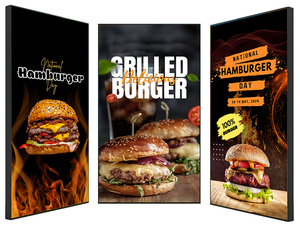
Restaurants, cafés, quick service operators and food halls tend to prioritise readability, layout consistency and easy content updates. Here, the best display is not always the most premium one. The right answer is usually a reliable commercial panel with good brightness, straightforward mounting options and the ability to run daily menus, pricing changes and promotions without fuss.
Where menu boards are mounted high above counters, viewing angles become especially important. A screen with poor off-axis performance can make text and pricing harder to read, which is a practical problem, not just a cosmetic one.
Corporate and reception spaces
Offices, showrooms and reception areas often need a cleaner presentation standard. These spaces may display brand messaging, visitor information, room schedules or internal communications, so display quality and integration with the surrounding fit-out matter more.
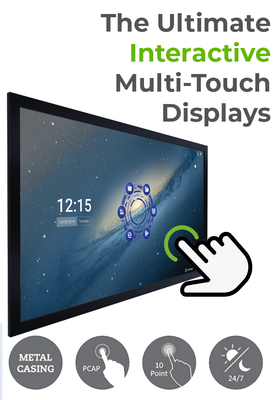
For this category, buyers often look at thin-bezel commercial panels, freestanding totems or meeting room signage displays. If the installation supports hybrid working or visitor management, touchscreen or interactive formats may also be appropriate. The trade-off is simple: higher design expectations usually push the requirement beyond a basic display-only purchase and towards a fuller hardware, software and installation package.
Education and public sector settings
Schools, colleges and public-facing buildings need equipment that is easy to manage and built to last. Internal comms screens, wayfinding displays and interactive information points all have different requirements, but reliability, central control and support are usually non-negotiable.
In education in particular, it is worth separating standard signage displays from interactive classroom screens. They may sit in the same buying cycle, but they solve different problems. A signage panel works well for notices, campus updates and welcome messaging, while an interactive display supports teaching, collaboration and annotation.
Outdoor and semi-outdoor installations
Outdoor digital signage is its own category. If a display is exposed to weather, variable temperatures or direct sun, a standard indoor commercial screen will not be enough. Buyers need to consider weather protection, cooling, glazing, brightness, anti-glare performance and enclosure specification alongside the screen itself.
This is an area where shortcuts tend to fail quickly. Semi-outdoor can be workable under shelter, but truly external installations need a purpose-built solution.
Key specifications that influence buying decisions
Resolution still matters, but for most business signage deployments, brightness, run time and connectivity shape the outcome more than a move from Full HD to 4K. If your content is text-heavy or viewed at close range, higher resolution can certainly help. For promotional loops viewed from distance, brightness and contrast usually have more immediate impact.
Screen size should be led by viewing distance and content layout rather than preference alone. A larger screen is not automatically better if the mounting position is awkward or the audience is close to the display. In menu board arrays, for example, consistency across the set often matters more than maximising size.
Integrated media players can be useful for simpler rollouts, especially where the goal is tidy installation and fewer external components. Dedicated external players, however, often provide more flexibility for larger networks, more advanced scheduling and easier servicing. It depends on how many screens are involved, how often content changes and whether the estate is likely to grow.
Connectivity should also be checked with the actual deployment in mind. HDMI input alone may cover a standalone display, but networked signage installations often need more thought around LAN, Wi-Fi, RS232 control, USB playback and CMS compatibility. Procurement teams should confirm the full signal path before ordering, not after the screen is on the wall.
Why commercial displays outperform consumer TVs
This comparison comes up in almost every budget discussion. On paper, a consumer TV can seem attractive. In commercial use, the limits appear quickly.
Commercial signage displays are designed for longer operation, professional mounting, remote management and repeatable deployment across multiple sites. They usually offer better warranty terms for business use and are less likely to run into problems with overheating, inconsistent panel quality or missing orientation support. They also present more practical options for portrait installation, brighter environments and signage-specific use.
The cost gap can narrow once you account for failure rates, replacement labour and the disruption caused when a customer-facing screen goes offline. For a single low-use screen in a low-risk environment, a buyer might weigh that compromise differently. For most business estates, dedicated commercial signage hardware is the safer decision.
Choosing the right format for your site
Not every signage project should start with a wall-mounted panel. Freestanding digital totems work well in entrances, exhibitions and retail promotions where floor presence is part of the brief. Hanging double-sided displays are effective in windows and central walkways where visibility from both directions matters. Video walls suit large-format brand messaging and control spaces, while touchscreen kiosks are the right fit where users need to search, browse or interact.
The best result usually comes from choosing the format before getting too attached to a specific screen model. A very good display in the wrong physical format can still underperform.
Support, installation and long-term value
For many buyers, the real differentiator is not the panel brand alone. It is the quality of the overall delivery. Site surveys, bracket selection, cable management, software setup, content planning and post-installation support all affect whether the display performs as expected.
This is where a specialist supplier adds value. Businesses that need one screen quickly may focus on stock availability and delivery times. Multi-site operators, trade resellers and facilities teams usually need more than that - specification guidance, consistent product sourcing, installation coordination and support when the network expands. Screen Moove is built around that end-to-end model, which is often what keeps projects on schedule.
The best digital signage displays are not just the brightest or the newest. They are the displays that fit the environment, work reliably under commercial demands and remain easy to manage after launch. Buy for the real conditions, not the brochure, and the screen will keep earning its place long after the installation team has left site.