


Most buyers start with the obvious questions. Screen size. Brightness. Resolution. Those matter - but panel type quietly determines how your digital signage actually looks once it is installed.
VA and IPS are the two dominant LCD panel technologies used in commercial displays today. They perform very differently. Choosing the wrong one for your environment can leave content looking washed out, colours shifting at an angle, or contrast failing in exactly the conditions your customers are standing in.
This guide explains what each panel technology does, where each one excels, and how to match the right choice to your specific environment.
What Is a Display Panel Type?
Commercial displays are built on LCD technology. LCD stands for liquid crystal display. The panel type refers to how the liquid crystals inside the screen are arranged and controlled.
That arrangement affects everything from how deep blacks appear to how well the image holds up when someone views the screen from the side.
The three most common panel types in commercial and digital signage displays are:
- VA - Vertical Alignment: often used in retail and advertising displays where contrast matters.
- IPS - In-Plane Switching: common in corporate, education and collaborative environments where wide viewing angles matter.
- ADS - Advanced Super Dimension Switch: an IPS-adjacent technology used in many commercial-grade displays.

What Is a VA Panel?
VA panels work by aligning liquid crystals vertically when no voltage is applied. This allows them to block light more completely than IPS panels, which is why they produce significantly deeper blacks and higher native contrast ratios.
Where VA Panels Perform Well
- High-contrast video content and motion graphics
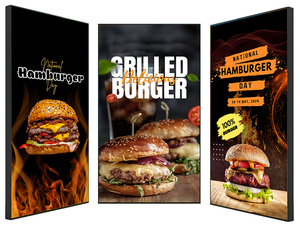
- Retail environments where impact and visual punch matter
- Darker indoor spaces where deep blacks add depth to content
- Digital menu boards where contrast between content and background is important
- Window-facing displays in lower ambient light conditions
Where VA Panels Are Weaker
VA panels are generally weaker at wider viewing angles. The image may shift in colour and brightness when viewed from a steep side angle. For displays mounted in corridors, wide shop floors or spaces where people approach from multiple directions, that is worth considering.
Best suited to: retail signage, digital menu boards, QSR environments, advertising displays, video walls and any application where high visual impact comes first.
What Is an IPS Panel?
IPS panels align liquid crystals horizontally, parallel to the glass substrates. This allows light to pass through more consistently across the full surface, giving IPS its defining characteristic: wide, stable viewing angles.
Where IPS Panels Perform Well
- Multi-directional viewing environments where the audience is not directly in front of the screen
- Colour accuracy and consistent image reproduction
- Meeting rooms, boardrooms and collaboration spaces
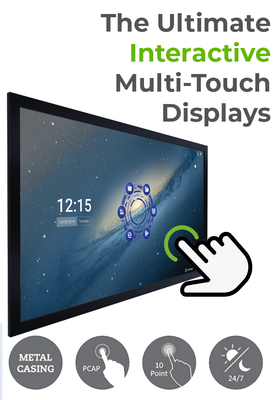
- Interactive displays where the user may be off-centre
- Healthcare and education spaces where legibility from different positions matters
Where IPS Panels Are Weaker
IPS panels usually have lower contrast than VA panels. Blacks can appear slightly greyer, particularly in darker environments. For ambient-lit retail or dim hospitality spaces, this can reduce the visual punch of content.
Best suited to: corporate AV, meeting rooms, interactive displays, education, healthcare waiting areas and any space where people view the screen from multiple angles.
What Is an ADS Panel?
ADS stands for Advanced Super Dimension Switch. It behaves similarly to IPS, offering wide viewing angles, accurate colour reproduction and good brightness uniformity. It is often found in commercial-grade displays at competitive price points.
If a display spec lists ADS, ADS-IPS or similar, it usually falls into the same practical performance category as IPS for most signage applications.
VA vs IPS - Side-by-Side Comparison
| Feature | VA | IPS / ADS |
|---|---|---|
| Contrast ratio | Excellent - deep blacks | Good - slightly lighter blacks |
| Viewing angles | Good - some shift at wider angles | Excellent - consistent from the side |
| Colour accuracy | Good | Excellent |
| Brightness uniformity | Very good | Excellent |
| Best content type | Video, bold graphics, high contrast | Presentations, data, collaboration |
| Typical commercial use | Retail, QSR, advertising | Corporate, education, healthcare |
| Price point | Often lower | Often higher |
There is no objectively better option. The right answer depends entirely on where the screen is going and what it needs to do.

Which Panel Type Is Right for Your Environment?
VA is often the stronger choice when you want deep contrast, bold graphics and visual impact on the shop floor.
VA panels are well-suited to digital menu boards where contrast and legibility at distance matter.
IPS is usually better for meeting rooms and shared screens because people view from different angles.
Use IPS or ADS for wide gym floors, and VA for high-impact reception or studio displays.
IPS is preferable where patients, visitors and staff may approach screens from multiple directions.
IPS or ADS is usually best for classrooms, lecture theatres and interactive teaching displays.
Retail and Shop Displays
For most retail applications, VA is the stronger choice. Shop floor signage needs visual impact - bold graphics, vivid product imagery and promotional content that stops foot traffic. VA's contrast advantage delivers this.
Browse commercial signage displays.
Digital Menu Boards and QSR
VA panels are well-suited to menu boards, where the primary need is high contrast between content and background. Text legibility at a distance improves with deeper blacks and stronger contrast.
View ScreenMoove's digital menu board range.
Gyms and Fitness Studios
Either panel type can work well in a gym context, depending on the space. For wide open gym floors where screens are viewed from across the room and at angles, IPS or ADS gives more consistent visibility. For impact screens in a studio or reception, VA's contrast makes a stronger first impression.
Corporate Offices and Meeting Rooms
IPS is the standard for corporate AV. Boardrooms, huddle rooms and presentation spaces have audiences viewing from varied positions around a table. Consistent colour and angles matter more than deep blacks in these contexts.
Healthcare and Waiting Areas
IPS is preferable in waiting room and corridor signage applications where patients, staff and visitors may approach from any direction. Consistent legibility from all angles is more important than contrast performance.
See healthcare digital signage solutions.
Education
IPS or ADS panels are the standard in education environments. Interactive displays for classrooms and lecture theatres need to perform from the back of the room, the side and everywhere in between.
Outdoor and High-Brightness Applications
For outdoor and window-facing environments, brightness is usually the dominant specification - not panel type. Ultra-high-brightness displays are engineered for direct sunlight readability and should be assessed by brightness, mounting location and content visibility.
Explore ultra-high-brightness displays.
 Panel type is only one part of the buying decision. Commercial build quality, brightness, warranty, operating hours and installation requirements also matter.
How to Check a Display's Panel Type Before Buying
Panel type is usually listed in the technical specifications of a commercial display. Before you buy, look for:
- Panel type or panel technology: this may state VA, IPS, ADS, AHVA or similar.
- Contrast ratio: a native contrast ratio of 3,000:1 or higher typically indicates VA. A contrast ratio around 1,000:1 to 1,200:1 is more typical of IPS.
- Viewing angles: 178°/178° is common on IPS and ADS displays, although some VA displays may list similar figures while still showing real-world side-angle shift.
Compare digital signage displays, menu boards, interactive displays and high-brightness screens for UK commercial environments.
Digital Signage DisplaysDigital Menu Boards
Interactive and Touchscreen Displays
Ultra High-Brightness Displays
The Right Panel Makes a Measurable Difference
Panel type is not a secondary specification. In the wrong environment, a display that ticks every other box - right size, right brightness, right price - can underperform simply because the viewing angle or contrast profile does not match how people actually interact with it in the space.
VA for impact. IPS for inclusivity. ADS for wide-angle commercial performance at a competitive price point. If you are not sure which direction your installation should go, the best conversation to have is with someone who understands both the technology and the environment it is going into.
Need help choosing between VA and IPS?
ScreenMoove can help you match the right commercial display panel technology to your space, content, budget and installation requirements.
Speak to ScreenMooveFrequently Asked Questions
What is the difference between VA and IPS panels?
VA panels offer higher contrast and deeper blacks, making them well-suited to retail, QSR and video content. IPS panels offer superior viewing angles and more accurate colour reproduction, making them a strong choice for corporate, education and collaborative environments.
Which panel type is best for digital menu boards?
VA panels are generally preferred for digital menu boards. The higher contrast ratio improves the visual separation between menu content and background content, which is important when customers are reading from a distance in a busy environment.
Does panel type affect brightness?
Panel type can influence brightness performance, but commercial display brightness is primarily determined by the backlight specification. For outdoor or high-brightness applications, look for displays with high cd/m² brightness ratings regardless of panel type.
Is IPS better than VA for commercial signage?
Not always. IPS is better for applications where viewing angle consistency matters, such as offices, meeting rooms, education and healthcare. VA is better for applications where contrast and visual impact are the priority, such as retail, menu boards and advertising displays.
What is an ADS panel in a commercial display?
ADS is a panel technology that performs similarly to IPS, offering wide viewing angles and accurate colour. It is commonly used in commercial-grade displays and can be treated as an IPS-style panel for most practical signage applications.
How do I find out what panel type a display uses?
Check the manufacturer's technical datasheet or product specification sheet. The panel type is usually listed under display technology or panel type. A native contrast ratio above 3,000:1 is often a useful indicator of a VA panel.
Speak to ScreenMoove about your display project
Get expert advice on VA, IPS, ADS, digital signage screens, interactive displays and commercial AV solutions. Call 020 8191 9223 or send us a message below.
Call ScreenMoove on 020 8191 9223 to discuss the best panel type for your commercial display project.


