


Case study
Digital Menu Board Buyer Guide for UK Sites
A menu board that looks sharp in a showroom can fail badly over a busy counter. Glare washes out pricing, consumer-grade panels overheat, and awkward content updates turn a simple daily special into a staff headache. This digital menu board buyer guide is built for business buyers who need a system that works reliably in real trading conditions, not just on paper.
What a digital menu board buyer guide should help you decide
Most buying mistakes happen before anyone compares brands. The real questions come first. How many screens do you need, where will they sit, how far away will customers be, and who will update the content? A small takeaway with a single counter display has very different requirements from a multi-site restaurant group managing breakfast, lunch and promotional changes across dozens of locations.
That is why the right buying approach starts with the use case, then moves to hardware, software and installation. If you begin with screen size alone, you can end up with a display that looks impressive but performs poorly in the space. Commercial digital menu boards should be chosen as part of a working signage system, with the display, media player, CMS and mounting all considered together.
Start with the environment, not the screen
In hospitality, the environment drives specification. A menu board installed behind a counter with controlled lighting can often run well on standard commercial brightness. A screen facing shopfront glass or strong downlighting usually needs a higher brightness panel to keep text readable throughout the day.
Viewing distance matters just as much. If customers stand close to the till, smaller text and more detailed layouts can work. In fast food, food courts or larger queueing areas, menu content needs stronger hierarchy, fewer lines per section and a screen size that supports quick reading from several metres away.
Operational hours also affect the decision. A café open eight hours a day may be fine with a 16/7 commercial panel. A quick service restaurant running long days, seven days a week, should be looking at heavier-duty commercial displays designed for extended or continuous use. This is one of the clearest dividing lines between a proper business display and a domestic TV.
Choosing the right screen size and layout
For many counters, 43 inch, 49 inch and 55 inch displays are the core range. The right choice depends on wall width, menu complexity and customer distance. A simple offer-led menu with a few categories can work well on 43 inch screens. A broader food and drink menu, especially with combos, modifiers or daypart content, often benefits from 49 inch or 55 inch panels.
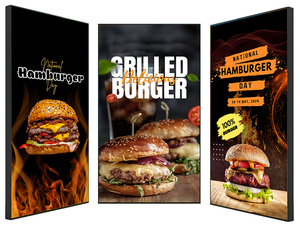
The next decision is orientation and screen count. A single landscape screen can suit compact sites with a focused menu. Two or three landscape screens are common where operators want a more structured layout, such as meals, drinks and promotions split clearly across the run. Portrait can work in specialist settings, but for most menu board installations, landscape remains the easiest format for pricing and category visibility.
Bezels are worth checking if you are placing multiple screens side by side. Thick borders can make a menu feel broken up. Slim bezel commercial displays create a cleaner finish, particularly in customer-facing food environments where presentation matters.
Brightness, resolution and readability
A good-looking image is not the same as a readable menu. For menu boards, readability comes from the balance between brightness, contrast, layout and font size. Full HD is still suitable for many standard menu board applications, especially on modest screen sizes, while 4K becomes more useful on larger screens or where richer branded content is part of the design.
Brightness should be chosen according to ambient light rather than marketing claims. Standard commercial indoor displays are often suitable for interior-facing counters. High brightness screens are a better fit for brightly lit venues or window-adjacent positions. If the display has to fight daylight, under-specifying brightness is a false economy.
Anti-glare performance also matters. A high brightness panel can still be unpleasant to read if reflections are strong. In hospitality, where customers make quick decisions, clear legibility usually matters more than cinematic image quality.
The media player and CMS are not add-ons
A surprising number of buyers focus on the display and treat content management as an afterthought. In practice, the media player and CMS determine how easy the system is to run. If prices change regularly, promotions rotate often or multiple sites need coordinated updates, software choice becomes central to the value of the whole investment.
A basic setup may only require simple scheduled playlists and manual content updates. A more advanced operation may need central control, template-based editing, localised pricing, timed breakfast-to-lunch switches and user permissions for different teams. If you run several sites, remote device monitoring and proof of playback are often worth considering as well.
There is also a practical hardware question here. Some commercial displays include built-in system-on-chip functionality, which can reduce the need for separate players in lighter-use deployments. Dedicated media players can offer more flexibility and processing power, particularly for multi-screen synchronisation, more dynamic content or larger signage networks. Neither option is automatically better. It depends on the complexity of the menu board estate and how much control you need.
Don’t overlook mounting, cabling and service access
A tidy menu board installation rarely happens by accident. Wall type, fixing points, cable routes, power availability and maintenance access all need planning before the screens arrive. This is especially important for multi-screen runs, where poor alignment is immediately visible to customers.
Mount choice affects both appearance and future servicing. Low-profile wall mounts can create a clean result, but you still need enough access for power, data and maintenance. In some sites, ceiling-mounted or suspended solutions are more appropriate, particularly where wall space is limited or there are counters and servery structures to work around.
If the installation is customer-facing, cabling should be hidden wherever possible. Exposed leads undermine the finish and can create avoidable safety or cleaning issues. For new fit-outs this is easier to plan. For retrofit projects, a site survey often saves time and rework.
Commercial screens versus consumer TVs
This is the comparison that causes the most procurement debate. A consumer TV may look cheaper at first glance, but the differences are significant. Commercial displays are designed for longer operating hours, better thermal management, business warranty terms and integration with signage hardware and software.
They also tend to offer features that matter in deployment, such as landscape or portrait operation, scheduling controls, RS232 or network management, VESA mounting compatibility and panel consistency across fleets. Consumer TVs can be tempting for a single small site, but if reliability, warranty support and long-term performance matter, they are usually the wrong tool for the job.
For operators with multiple locations, standardising on commercial hardware is usually the safer route. It simplifies support, replacement planning and content deployment.
Budgeting properly in a digital menu board buyer guide
The screen is only one line in the budget. A realistic menu board cost should include the display or displays, mounts, media players if required, CMS licensing, content design, installation, cabling and any ongoing support. If you need network upgrades or electrical work, those should be allowed for early as well.
There is no single right budget because site requirements vary widely. A straightforward single-screen setup is very different from a three-screen branded installation with centrally managed software across multiple branches. What matters is knowing where the cost sits and what each element contributes to the outcome.
It also helps to think beyond purchase price. Downtime, difficult updates, weak brightness and short product life all carry an operational cost. In hospitality, where menus directly affect sales and queue speed, buying cheaply can become expensive quite quickly.
Questions to ask before you buy
A strong supplier should be able to guide the specification rather than simply quote a screen. Ask what operating hours the display is rated for, whether the brightness suits your environment, how content will be updated, and what support is available after installation. Check warranty terms, CMS options and whether the proposed setup can scale if you add more sites later.
You should also ask how the system will be installed and serviced. Many menu board problems are not product faults at all. They come from poor mounting, incompatible players, badly planned content zones or unrealistic assumptions about who will manage updates internally.
For buyers managing procurement across multiple branches, consistency matters. It is often better to approve a standard menu board specification that can be repeated, with room for small local variations, than to let each site source different hardware.
Making the right choice for your site
The best digital menu board is not the one with the longest spec sheet. It is the one that fits the environment, supports the way your team works and keeps content clear for customers during every trading hour. For some venues, that means a simple commercial display with an easy CMS. For others, it means a multi-screen network with central scheduling, higher brightness and professional installation.
That is where specialist support adds value. A supplier focused on commercial AV can help align screen type, software, mounts and rollout planning so the system works as a whole, not as a collection of parts.
If you are buying for one site or one hundred, treat the menu board as an operational asset rather than a screen purchase. The right setup should make pricing changes faster, improve presentation at the point of sale and keep working without constant intervention.