


Case study
Digital Signage Displays for Business Explained
A poster in the window cannot change by the hour, react to stock levels, or switch from promotion to wayfinding before a busy event starts. That is why digital signage displays for business have moved from a nice-to-have upgrade to a practical part of day-to-day operations across retail, hospitality, education and corporate spaces.
For most buyers, the question is not whether digital signage works. It is which display format, brightness level, mounting method and software setup will actually suit the site, the content and the people managing it. That is where many projects either become efficient and scalable, or expensive and awkward to maintain.
What digital signage displays for business actually need to do
Commercial display buying starts with purpose, not screen size. A menu board in a quick-service restaurant has a different job from a reception display in a corporate office, a double-sided hanging screen in a shopping centre, or an outdoor totem outside a dealership.
The best digital signage displays for business do three things well. They stay visible in the conditions they are installed in, they run reliably for long operating hours, and they support content management without creating more work for staff. Consumer TVs often fall short here. They may look cost-effective at first, but lower brightness, limited warranty terms, weaker cooling, and fewer commercial control features usually make them the wrong fit for professional deployment.
This is especially true when screens are expected to run 16/7 or 24/7, operate across multiple locations, or integrate with players, scheduling tools and remote management software. Business buyers need hardware designed for commercial usage, not repurposed home entertainment products.
Choosing the right display type for the environment
There is no single best screen for every setting. The right choice depends on viewing distance, ambient light, available space and the role the display plays in the customer journey.
Indoor wall-mounted displays
These are often the starting point for retail stores, reception areas, waiting rooms and internal communications. They suit promotional messaging, brand content, notices and information feeds. Sizes typically range from smaller 32 inch formats up to large-format 86 inch and above, depending on the wall space and the viewing area.
Brightness matters more than many first-time buyers expect. In a standard indoor environment, a commercial display with suitable brightness may be perfectly adequate. In a bright atrium, shopfront or window-facing position, a higher brightness panel becomes far more important than simply moving up in size.
Window and storefront screens
A storefront display has one job above all else - cut through glare and daylight. If the content cannot be read from outside, the installation is not doing its job. High brightness screens are usually essential here, especially in south-facing units or sites with strong ambient light.
This is also where thermal performance and proper installation matter. Window-facing screens deal with heat, reflections and long operating hours, so the specification needs to reflect real conditions rather than a best-case showroom setup.
Digital menu boards
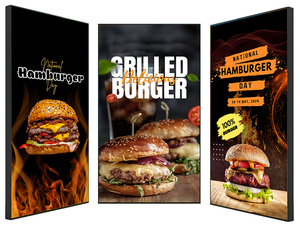
Restaurants, cafés, takeaways and hospitality groups often need a display network that is easy to update, visually consistent and simple for teams to manage. Menu boards are less about flashy hardware and more about dependable readability, clear content layouts and straightforward scheduling.
The practical consideration is usually the overall layout. A single large display can work well in some spaces, but a multi-screen menu board often gives better flexibility for pricing, featured items and daypart changes.
Freestanding totems and kiosks
When wall space is limited or a stronger visual presence is needed, freestanding displays make sense. Totems work well in retail, leisure, showrooms and public venues where wayfinding, promotions or self-service interaction are part of the requirement.
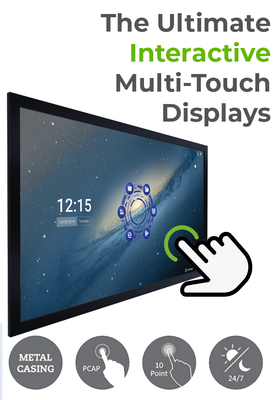
If touch is involved, the specification changes again. Glass strength, operating system compatibility, player choice and user flow all become part of the buying decision. A touchscreen kiosk that looks good but frustrates users is not an upgrade.
Outdoor digital signage
Outdoor screens are a separate category, not just indoor displays in a stronger housing. Weather resistance, temperature management, daylight readability and enclosure design all matter. This is where buyers need to be realistic about cost. Outdoor signage requires more from the hardware, the mounting and the installation, but it opens up high-impact visibility that static signage cannot match.
Specification points that affect performance
Business buyers are often presented with long product sheets, but a handful of specifications usually have the biggest operational impact.
Brightness is one of the first. A display that looks fine in a controlled room can struggle badly in a window or open-plan site with heavy natural light. Resolution matters too, but only in context. For many signage applications, Full HD may still be perfectly workable, while larger screens and close-viewing environments may justify 4K.
Operating hours are another key factor. If the screen will run all day, every day, commercial duty ratings are not optional. Orientation also matters. Not every display is suitable for portrait mounting, and this catches out buyers who assume a landscape screen can simply be rotated.
The media setup needs attention as well. Some displays have built-in system-on-chip capability for certain signage platforms, while others are better paired with external players for more control and flexibility. Neither approach is automatically better. It depends on the complexity of the content, the scale of the network and the level of remote management required.
Software, players and control across locations
Hardware gets the attention, but software is what makes signage manageable once it is live. If a business has more than one screen, content control quickly becomes a practical issue.
The main question is how updates will be handled. A single-site business may need a straightforward setup for promotions, notices or menu changes. A multi-site operator needs central control, scheduled publishing, user permissions and confidence that updates reach the right screens at the right time.
This is where a white-label CMS, compatible media players and technical support can make a major difference. The point is not to add complexity. It is to reduce manual effort and keep the signage estate consistent. A strong signage network should allow teams to change content quickly without needing an AV specialist every time a campaign changes.
Installation is part of the purchase, not an afterthought
A well-specified display can still underperform if the installation is wrong. Mounting height, cable routing, ventilation, power access and viewing angles all affect the result. This is particularly important for video walls, suspended displays, shopfront screens and any larger multi-screen arrangement.
For facilities teams and procurement leads, this is often where project risk sits. The hardware may be correct, but site conditions, timetable pressure and coordination between trades can derail delivery. Working with a supplier that can source, advise, install and support the system reduces handover problems and limits the gap between product selection and real-world performance.
In practice, that joined-up approach matters most on multi-site rollouts, refurbishments and custom deployments. Standard off-the-shelf buying works for some jobs, but many commercial signage projects need more than a boxed screen and a bracket.
Where businesses tend to get it wrong
The most common mistake is buying on price alone. That usually leads to under-specified brightness, the wrong operating rating or a software setup that does not scale. The second mistake is treating all commercial displays as interchangeable. They are not.
A boardroom display, a retail window screen and an outdoor kiosk may all sit under the same broad category, but the requirements are completely different. Buyers also sometimes underestimate content. Even excellent hardware will have limited effect if the messaging is crowded, badly timed or designed without the viewing distance in mind.
There is also a trade-off between speed and tailoring. Fast fulfilment is valuable, particularly for urgent replacements or standard rollouts, but some environments need a more considered specification. The right choice depends on whether the project is straightforward or site-specific.
A better way to buy digital signage displays for business
The strongest signage projects begin with a simple commercial question: what should the display change for the business? That could be better promotion visibility, quicker content updates, improved customer flow, more professional meeting spaces or clearer internal communication.
From there, the buying process becomes much easier to structure. Screen type, brightness, size, player compatibility, software and installation can be matched to the outcome rather than selected in isolation. For UK organisations managing customer-facing spaces, education sites, hospitality venues or corporate environments, that approach tends to produce better value than chasing a low headline price.
Screen Moove works in that practical middle ground between product supply and project delivery - helping buyers source the right commercial display hardware, software and support without overcomplicating the decision. When the specification matches the environment and the content plan matches the business goal, digital signage stops being a screen on a wall and starts doing the job it was bought for.
If you are planning a new rollout or replacing an underperforming setup, the best next step is not to ask which screen is most popular. It is to ask which display will still be the right one after the first busy week, the first content change and the first year of daily use.