
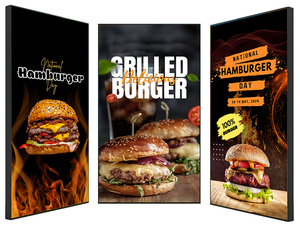
High-brightness window displays
- Designed for daylight and reflections
- Ideal for shopfront advertising
- Sharper close-range detail than LED
LED and LCD are both used in business signage, but they solve different problems. This guide breaks down how each technology works, where it performs best, and which ScreenMoove options make sense for retail windows, restaurants, offices and large-format installations.
Tip: Choose based on viewing distance and lighting - not just “which is newer”.
A practical breakdown that helps you choose the right display for your space.
Most business signage uses commercial LCD because it is sharp, cost-effective and ideal for close viewing (menus, pricing, promos). Direct View LED is best when you need huge, seamless impact or very high brightness for large-format / outdoor installs.
Want a fast recommendation?LCD stands for Liquid Crystal Display. LCD screens use a backlight to produce brightness, then liquid crystals and colour filters control the light to create the final image. This is why LCD displays are known for crisp detail - they are excellent at rendering text, pricing, menus and high-resolution imagery.
Many people get confused because modern LCD screens often use LED backlights. That does not make them “Direct View LED” - they are still LCD panels, just with a more efficient backlight.

Direct View LED is a different technology entirely. There is no backlight and no liquid crystal layer. Instead, the screen is built from thousands of tiny LEDs (red, green and blue) that emit light directly. Panels connect together to create a larger screen, often with no visible joins.
This makes LED ideal for huge, high-impact installs where you want a seamless wall of content, and for environments where extreme brightness is required.

LED can reach very high brightness for outdoor use. LCD can still be extremely bright with high brightness panels, making it excellent for shop windows and well-lit interiors.
LCD delivers crisp pixel density for close viewing and fine text. LED clarity depends on pixel pitch - the closer people stand, the finer pitch (and higher cost) you will need.
LCD is ideal when customers stand a few metres away reading prices and offers. LED shines when people view from further away and you need scale.
LED walls can be seamless with no bezel lines. LCD video walls have thin bezels - still impressive, but panel joins are typically visible.
LCD is faster to install and generally more cost-effective. LED is modular, custom built, and often requires specialist installation and higher budget.
LCD tends to be efficient for fixed-size signage. LED varies based on brightness and scale - large installs can consume more power depending on usage.

For storefront advertising, the biggest problem is visibility in daylight. High brightness LCD displays are designed for this, giving you sharp visuals, strong contrast and readable English messaging even with reflections on the glass.
They also make scaling to multiple locations simpler because you can deploy consistent screen sizes and mounts.


Digital menu boards are typically viewed from a short distance, so sharp resolution and clear pricing text are essential. Commercial LCD displays are ideal here - they keep food photography vibrant and make English pricing and offer text easy to read during busy service.
LCD also supports multi-screen menu layouts without the cost and complexity of LED.
If you want a wow-factor wall with no visible panel joins, Direct View LED is the premium option. It is designed for scale and can create an immersive branded backdrop in flagship spaces, venues and large reception areas.


LCD video walls combine multiple screens to create a bigger canvas. You will usually see thin bezel lines, but you get an impressive large-format result at a lower overall cost than a comparable LED wall - especially for control rooms, offices and retail interiors.
When customers stand around 2 metres away, LCD tends to look sharper and cleaner for detailed information like pricing, specifications, offers and QR codes. This is one of the main reasons LCD dominates everyday business signage.

For most retail, hospitality and business environments, commercial LCD is the best all-round choice because it delivers sharp visuals at close range, installs easily, and keeps budgets sensible when you are rolling out multiple screens.
Direct View LED is best when scale is the goal - large feature walls, long viewing distances, outdoor advertising, and premium “wow” installations where seamless visuals matter more than fine text detail.
Tell ScreenMoove where the screen will go (window, wall, counter), how far viewers stand, and your operating hours - we will recommend the right option.
Start with the right commercial display for your lighting and viewing distance, then build your signage network from there.
Share where the screen will be installed (window, wall, counter), how far viewers stand, and your operating hours. We will recommend the best fit and share pricing.
By submitting this form you agree to be contacted by ScreenMoove about your enquiry.