Skip to content
Free Next Working Day Delivery On Orders Over £100 ex VAT.
Courier services operating with same-day dispatch, subject to network capacity.*
24/7 Commercial Screens vs Consumer TVs for Business (2026 Guide)
12965CLPROXTR

24/7 Commercial Screens vs Consumer TVs for Business (2026 Guide)

Published March 3, 2026

2026 Guide - Digital Signage Hardware

24/7 Commercial Screens vs Consumer TVs for Business

If you are using a standard TV as a business display, you may be sacrificing brightness, reliability, and warranty cover. Here is what really changes when you upgrade to a purpose-built 24/7 commercial screen - and which ScreenMoove products fit each use case.

Best for: Retail, Takeaways, Gyms, Offices Topics: Brightness, 24/7 runtime, CMS, Warranty Support: UK supply + advice
Commercial screen vs TV for business - visual comparison Tip: If your screen is customer-facing, it is part of your brand experience - clarity matters.

Quick answer

A consumer TV might look fine on day one, but it is not engineered for long daily runtime, bright environments, portrait installs, or commercial warranties. For customer-facing signage, a 24/7 screen is the reliable choice.

Need help choosing?

What is a 24/7 commercial display?

A 24/7 commercial display is built specifically for business environments where screens run for long hours, operate in brighter spaces, and need to be dependable day after day. Unlike a domestic television, a commercial panel is engineered with components and firmware designed for signage use.

Commercial screens typically support professional mounting standards, signage modes, and remote management options. They are also backed by warranties intended for business use.

Rule of thumb: If your screen is on for most of the day, faces customers, or sits near daylight - choose commercial.
Business environment showing a digital signage screen in use

Key differences vs consumer TVs

1) Operating hours and thermal design

Most consumer TVs are designed for evening viewing, not continuous operation. Leave a TV running all day in a busy space and you may see faster wear, instability, or failure. 24/7 signage displays are engineered for long runtime with better thermal management and commercial-grade internals.

2) Brightness and visibility

Brightness is measured in nits (cd/m²). A typical TV is fine in a living room, but can look washed out in a window, front counter, or brightly lit retail space. Commercial displays offer higher brightness options so your content stays readable and impactful.

  • Typical TV: often around 250 to 350 nits
  • Commercial signage: commonly 500 to 700 nits
  • High brightness signage: 700 nits and above for demanding environments

3) Warranty coverage for business use

Many consumer TV warranties are not intended for commercial installations. That means if it fails in a business setting, you may not be covered. Commercial displays are sold with business use in mind - which helps protect your investment.

4) Portrait mounting and signage orientation

Portrait signage is common for retail posters, promotions, and wayfinding. Consumer TVs are rarely designed for portrait operation, and rotating them can cause heat and performance issues. Commercial displays are built to support portrait and landscape installs properly.

5) Remote content control and signage features

Commercial screens are designed to work with digital signage players, Android signage systems, and CMS tools. This makes it easier to update content, schedule campaigns, and manage multiple screens.

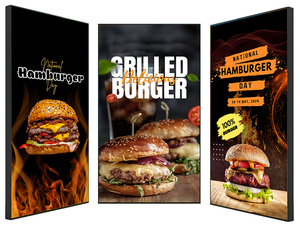
Visual showing content visibility difference between TV and commercial screen

The hidden cost of using a TV

A TV can feel cheaper up front, but it often costs more over time - especially when it is running every day and driving customer decisions.

  • Downtime: a failed screen during trading hours means lost attention and lost revenue
  • Visibility loss: washed-out content reduces footfall conversion
  • Extra replacements: shorter lifespan means re-buying sooner
  • Brand impact: low brightness and DIY setups can look unprofessional
If your screen is your silent salesperson, reliability is not optional.

Best upgrade path

Start with one high-impact commercial screen in your highest traffic area (shop window, counter, entrance), then scale to more screens once you see the lift in attention and conversions.

See commercial display range

Real-world use cases (and what works best)

Retail shop windows

Use high brightness screens to cut through daylight and reflections. Ideal for promotions, seasonal campaigns, and video that stops people mid-walk.

Takeaways and restaurants

Digital menu boards let you update prices instantly, run upsells, and remove printing costs. Commercial screens handle long daily runtime reliably.

Gyms and studios

Timetables, class promos, and membership offers benefit from remote scheduling and consistent brightness in well-lit spaces.

Offices and reception

Welcome screens, internal comms, and dashboards look sharper on commercial panels designed for professional installs and consistent uptime.

FAQs

Can I use a TV for digital signage in my business?
You can, but it is often a short-term fix. TVs are not built for long daily runtime, bright environments, or commercial warranty use. If the screen is customer-facing, a 24/7 commercial display is usually the better investment.
What brightness do I need for a shop window?
For window-facing screens, higher brightness helps overcome daylight and reflections. If your current screen looks washed out in the daytime, move to a higher nit commercial panel (for example 700 cd/m² and above depending on your conditions).
Will a commercial screen work in portrait?
Yes - many commercial signage displays are designed for portrait and landscape operation. That is one of the key advantages over consumer TVs, which are typically not built for portrait installs.
Do I need signage software?
Not always. Some businesses start with simple playback using built-in Android signage features, then upgrade to a CMS for scheduling, remote updates, and multi-site management. ScreenMoove can advise based on how often you change content.

Get advice on the right 24/7 screen

Tell us where the screen will be installed (window, counter, wall, reception), your preferred size, and how many hours per day it will run. We will recommend suitable commercial options and share pricing.

Prefer to speak?
Call 020 8191 9223

Contact ScreenMoove

We aim to respond as quickly as possible on business days.

By submitting this form you agree to be contacted by ScreenMoove about your enquiry.

Previous article LED vs LCD Displays - What’s the Difference and Which Is Best? (2026 Guide)
Next article How to Configure an LCD Video Wall Display