


Blog post
Commercial Digital Signage Buying Guide for UK
A screen that looks excellent in a showroom can fail quickly above a busy service counter, fade in a sunlit window or become impossible to manage across multiple sites. This commercial digital signage buying guide focuses on the decisions that protect your investment: choosing commercial-grade hardware, matching brightness to the environment, planning content management and allowing for installation from the start.
Start with the business outcome, not the screen size
Digital signage should have a defined job. A restaurant may need menu boards that make prices and promotions easy to update. A retailer may be trying to stop passers-by outside the shop window. An office could need clear visitor communications, room availability or staff announcements. The right specification follows that objective.
Begin by deciding what each screen must achieve, who will manage the content and how often it will change. A single reception display with a rotating welcome message has very different requirements from a multi-site network publishing daily offers and local information. This early clarity prevents two common problems: paying for functions that will never be used, or installing displays that cannot support the operation as it grows.
Screen size matters, but viewing distance matters more. A display viewed from a few metres away can show detailed pricing, QR codes and product information. Content intended for a large retail aisle, hotel lobby or sports venue needs larger text, stronger contrast and a screen large enough to be understood at a glance. Plan the physical position before settling on a diagonal size.
Buy commercial displays, not consumer televisions
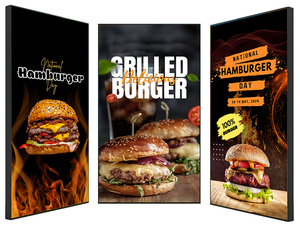
For business use, commercial digital signage displays are the safer long-term choice. They are designed for extended operating hours, often 16/7 or 24/7, with stronger thermal management, landscape and portrait operation, professional connections and manufacturer warranties intended for commercial environments.
Consumer televisions can appear attractive on upfront price, particularly for a small installation. However, their warranty may not cover continuous public use, their brightness is often limited, and portrait mounting can cause heat issues. Replacing failed screens, arranging access and recreating a consistent estate can quickly cost more than specifying correctly at the outset.
Check the duty cycle against the actual schedule. A café display running from breakfast through late evening may need a 16/7-rated panel, while an airport, hospital or 24-hour gym is likely to require a 24/7 display. Also confirm whether the display has an integrated media player or needs an external signage player. Built-in system-on-chip players reduce hardware and cabling, whereas dedicated players can offer more processing power, specialised applications or easier standardisation across a complex network.
Resolution and orientation
4K is now a sensible choice for many medium and large displays, especially where viewers stand close to the screen or content contains product imagery, menus and fine text. Full HD remains practical for smaller screens, simple messaging and viewing distances where extra pixels will not be noticed. Do not let resolution distract from legibility: a well-designed Full HD menu board is more effective than a crowded 4K layout.
Consider orientation early. Portrait displays work well for promotional posters, wayfinding and narrow wall spaces. Landscape is usually more natural for menus, meeting rooms and video content. If a screen will be mounted in portrait, confirm it is approved for portrait operation rather than simply rotating a standard television.
Brightness is the specification buyers most often underestimate
Brightness is measured in nits or candelas per square metre. It determines whether a message remains visible when competing with daylight, overhead lighting or reflections. Standard indoor commercial displays commonly sit around 350 to 500 nits. This can be suitable for offices, classrooms, corridors and many hospitality spaces where lighting is controlled.
For shop windows and bright public-facing areas, high-brightness displays are normally required. A 2,500-nit or higher window display can remain visible in strong daylight, while a standard indoor panel may look washed out by mid-morning. The correct rating depends on the screen’s direction, glazing, shading and local sunlight, so a site assessment is worthwhile for prominent window installations.
Outdoor digital signage needs more than high brightness. Look for a purpose-built enclosure, weather protection, appropriate operating temperature range, anti-glare treatment, ventilation or cooling, and secure access for maintenance. An indoor display placed in a weatherproof box is rarely an equivalent substitute. Heat build-up, condensation and service access all need to be considered.
Specify the installation as part of the solution
The display is only one component. Mounting, power, data, cable routes and maintenance access determine whether the finished installation looks professional and remains serviceable.
Wall-mounted screens require a suitable substrate and a bracket rated for the display’s size and weight. Tilt or pull-out mounts can help where viewing angles or rear access matter. For windows, freestanding digital totems, ceiling mounts and hanging double-sided displays, structural loading and cable management need particular attention. In public areas, use secure, tamper-resistant hardware and avoid placing cables where they can be pulled, trapped or become a trip hazard.
Plan power and network access at every location. Wired Ethernet is typically the most dependable option for high-use screens and video walls. Wi-Fi can work well where coverage is proven and content is modest, but it should not be assumed to be reliable through dense walls, busy kitchens or large sites. For critical communications, ask how the screen behaves if the internet connection drops. A capable player should continue to show cached content rather than going blank.
Choose signage software around the people using it
Digital signage software should make routine publishing straightforward without giving every user the ability to alter network-wide settings. A cloud-based CMS is often the most practical route for organisations managing more than one screen or site, allowing approved users to schedule content remotely and monitor player status.
Assess the software using your real workflow. Can a restaurant manager update a price in minutes? Can head office publish a campaign to selected branches while allowing local managers to add site-specific messages? Can content be scheduled by daypart, so breakfast, lunch and evening offers change automatically? These operational details matter more than an impressive feature list.
Confirm support for the content you will genuinely use: images, video, HTML pages, feeds, dashboards, room-booking information or menu integrations. Ask about user permissions, proof-of-play reporting where advertising revenue is involved, and whether the platform can scale without making licensing difficult to predict. Screen Moove can supply displays, players, CMS software and installation as a coordinated commercial solution, which reduces compatibility risk during procurement.
Budget for ownership, not only purchase price
A meaningful comparison includes the display, player if required, mount or enclosure, installation, cabling, software licence, network provision and future support. For a multi-site roll-out, standardising on a defined specification makes spares, content templates and technical support easier to manage.
Warranty terms deserve close attention. Check the length of cover, whether it applies to the intended operating hours, how faults are handled and whether advanced replacement is available. A lower-priced screen is less appealing if a failure leaves a menu board, window campaign or public information point out of service for weeks.
Energy use is also relevant for screens operating long hours. Automatic brightness controls, scheduled on/off times and content that avoids permanently displaying high-intensity white areas can reduce running costs and help prolong panel life. A screen does not need to be on overnight simply because the premises are closed.
Questions to answer before placing an order
Before final approval, confirm the location, viewing distance, operating hours, orientation, ambient light level, mounting method, power point, network route, content owner and software licence model. For video walls, also establish bezel width, controller requirements, calibration expectations and access for replacing an individual panel.
If the project includes several environments, avoid applying one specification everywhere. A 500-nit staff noticeboard, a high-brightness shop window display and a weatherproof outdoor totem have different demands. Using the right category for each location is usually more cost-effective than over-specifying every screen or accepting compromises in the most visible areas.
The best digital signage purchase is one that staff can update confidently, customers can read immediately and your technical team can support without constant intervention. Specify the working environment honestly, build the display network around that reality, and the screens will keep doing their job long after the launch campaign has changed.


