


Blog post
Which Digital Signage Software Features Matter?
A digital menu board that shows yesterday’s prices at lunchtime, or a reception screen that goes blank during a client visit, can quickly undermine the value of the hardware behind it. Which digital signage software features matter is therefore not just an IT question. It is a practical buying decision that affects brand consistency, staff workload and the reliability of every customer-facing screen.
The right platform should make content simple to control across one display or hundreds, while working reliably with the commercial screens, media players and network conditions in your estate. Not every business needs every feature. A single independent café has different priorities from a retailer with 40 branches or a college communicating across multiple buildings. The key is to assess software against the job your screens must do.
Which digital signage software features matter most?
For most commercial installations, the essentials are central content management, reliable scheduling, remote device monitoring, media support and sensible user permissions. These functions determine whether the system saves time after installation or creates a new daily task for staff.
Start with the content management system, or CMS. It should give authorised users a clear browser-based dashboard where they can upload images and video, build layouts, assign content to screens and check what is currently playing. A CMS that is technically capable but difficult to navigate often leads to inconsistent content and an over-reliance on one trained employee.
Look for templates and layout tools that match your intended applications. Restaurants may need price, product image and allergen-ready menu layouts. Corporate teams may need branded communications, meeting room information and data feeds. Retailers may need promotions that can be adapted quickly for local stock, campaigns and seasonal trading. Templates provide speed, but they should not force every message into the same inflexible design.
Scheduling that reflects real trading hours
Scheduling is where digital signage becomes more useful than a static poster. A capable platform should let you set content by time, date, day of the week, screen group and location. That means breakfast menus can change automatically to lunch, happy-hour messaging can appear at the correct time, and reception screens can switch to event information without someone visiting the site.
Check how easily the system manages exceptions. Bank holidays, one-off events, emergency notices and campaign extensions are common operational realities. You should be able to override normal playlists quickly, then return to the scheduled programme automatically afterwards. For multi-site organisations, local managers may need control over selected screens while head office retains approval of core campaigns.
Remote management and proof of playback
A screen network is only valuable when it is live and displaying the intended content. Remote monitoring lets support teams see whether players are online, whether screens are reporting faults and when devices last checked in. This is particularly valuable for window displays, menu boards and displays installed across geographically dispersed sites.
Proof of playback is another feature worth assessing. It records whether scheduled content was delivered and played, providing a useful audit trail for internal campaigns, landlord obligations or paid advertising arrangements. It cannot replace a visual site check entirely, but it gives operations teams a much clearer picture of network performance.
The quality of device management matters as much as the availability of a status screen. Look for alerts, remote reboot options, player software updates and diagnostics that can reduce unnecessary site visits. These capabilities can lower support costs over the life of a deployment, especially where screens are mounted at height or located in multiple branches.
Choose media support for your actual content plan
Digital signage software needs to handle the files and information sources your business will genuinely use. Standard image and video support is expected, but it is worth confirming acceptable formats, file size limits and recommended resolutions. Poorly prepared video can cause slow uploads, poor playback or unnecessary strain on a media player.
Web pages, HTML content, RSS feeds, weather information, social content and data dashboards can add value in the right setting. A gym may use live class schedules. A corporate office could display workplace announcements and performance data. A transport hub may need live arrival information. However, every live data source introduces another dependency. If the feed fails, the platform should show a suitable fallback message rather than a blank area on screen.
For menu boards, pricing control deserves particular attention. If prices are maintained in a point-of-sale system or spreadsheet, ask whether the signage platform can import or integrate that information reliably. Manual changes may be acceptable for a small menu, but they become risky across several sites. Any integration should be tested carefully before launch, including what happens when product data is unavailable.
Screen grouping and scalable control
Grouping displays by location, department, orientation or screen type makes large installations manageable. A retail chain may need a national promotion on all screens, regional pricing on selected locations and individual store messages on a single display. The software should make these layers of control clear rather than allowing content assignments to become confusing.
This is also important when a site has a mixture of landscape displays, portrait window screens, video walls and touchscreen kiosks. One layout rarely fits every format. The CMS should support tailored content zones and screen resolutions, while keeping the workflow practical for the people creating content.
If expansion is likely, consider licence management early. Some platforms charge by screen, others by player or feature tier. Low entry costs can become less attractive when monitoring, advanced scheduling or integrations are added later. A transparent view of ongoing software costs helps procurement teams compare systems on their full operational value, not only their initial price.
Security, permissions and dependable access
Digital signage is part of your business communications infrastructure, so access controls should not be treated as an optional extra. Role-based permissions allow administrators, marketing teams, local managers and external content agencies to use the platform without giving everyone unrestricted control. A school, for example, may want staff to update departmental notices but reserve whole-site emergency messaging for central administration.
Ask whether the platform supports secure login methods, multi-factor authentication and activity records. Audit logs are useful when content changes need to be traced, particularly in regulated, public-facing or multi-user environments. The ability to remove access promptly when staff or agencies change is equally important.
Network resilience needs practical consideration too. Most players download content and retain it locally, so screens can continue playing if an internet connection drops temporarily. Confirm how the system behaves offline, how long content is stored and whether emergency updates require a live connection. In venues with restricted networks, involve IT teams early to establish firewall, Wi-Fi and device-management requirements.
Player compatibility and hardware fit
Software does not operate in isolation. Before committing, confirm whether it runs on a dedicated media player, an integrated system-on-chip display, a Windows device or a supported third-party player. Each route has trade-offs.
Integrated signage players can reduce hardware at the screen and suit straightforward messaging applications. Dedicated commercial media players can offer stronger performance, wider compatibility and more control for demanding content, multi-zone layouts or larger networks. Touchscreen applications, video walls and high-brightness window displays may require more specific hardware planning than a basic reception screen.
A reliable supplier should assess the CMS, player and display as one solution. Screen Moove supports businesses with commercial display hardware, software, installation and technical guidance, helping ensure that the components selected are suitable for the intended environment rather than simply compatible on paper.
Features that add value in specific environments
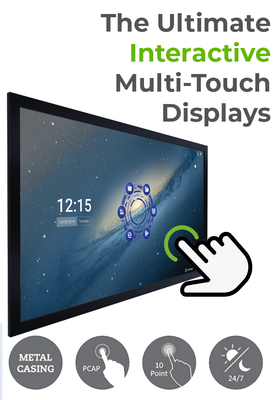
Some functions matter only when they solve a defined business problem. Touch capability is useful for self-service directories, visitor check-in and product browsing, but unnecessary for a passive advertising display. Audience measurement can help retailers assess campaign performance, though privacy obligations and the quality of the data must be considered carefully.
Emergency messaging is highly valuable for schools, healthcare sites, public buildings and larger workplaces. The system should provide a controlled route to override ordinary content, with clear permissions and a tested procedure. Interactivity, QR codes and live dashboards can also be effective, but only when the screen placement, user journey and content ownership have been planned properly.
Do not buy advanced features simply because they appear on a specification sheet. A simpler platform that staff use confidently will usually outperform an elaborate system that nobody has time to manage.
Questions to ask before selecting a platform
Before comparing software providers, define who will update content, how often it will change and who is responsible when a screen goes offline. Establish the number of displays, locations, orientations and user accounts required in the first year, then allow for realistic growth.
It is also sensible to request a demonstration using your own content scenarios. Ask the provider to show a timed menu change, a multi-site campaign, a local screen override, a player fault alert and the process for publishing an emergency message. These everyday tasks reveal more than a polished dashboard tour.
The best digital signage software is not the platform with the longest feature list. It is the one that gives your team confident control, keeps screens working and supports the next stage of your display estate without creating unnecessary complexity.


