Skip to content
Free Next Working Day Delivery On Orders Over £100 ex VAT.
Trade customer? Call 0208 1919 223 for exclusive trade pricing and priority stock access.*
Audio Visual Systems

Meeting Room AV Glossary: Key Terms Explained

Published July 28, 2026
Meeting room AV glossary

Meeting Room AV Glossary: Key Terms Explained

A plain-English guide to displays, video conferencing, audio, control systems and the terminology used in meeting room AV quotations.

Premium boardroom with a large commercial display and video conferencing setup

If you have ever sat through a meeting room AV quote and nodded along to terms such as “PTZ”, “BYOM” and “matrix switcher” without being entirely sure what they meant, you are not alone.

Most people specifying a meeting room are not AV engineers. They are office managers, IT generalists, facilities leads or business owners trying to make a sensible decision about equipment they will use every day but rarely need to think about.

AV vocabulary is often used as shorthand between suppliers, but that shorthand is not always translated into plain English for the person signing off the purchase order. For a complete overview of planning, specifying and installing a room, explore our meeting room AV solutions. This glossary closes that gap. It is organised by screens, cameras, audio, control and software, so you can jump directly to the section that matches the part of your quotation or specification that needs explaining.


Displays and visuals

Meeting room display terminology

These terms describe the screen itself, its picture quality, how it is mounted and whether it supports interactive collaboration.

Commercial display installed in a modern meeting room

4K UHD

4K refers to a screen resolution of 3840 × 2160 pixels, roughly four times the detail of standard Full HD. In meeting rooms, 4K matters most when people need to read fine text, spreadsheets or detailed diagrams from a distance. For simple slide decks viewed from a few metres away, Full HD can still be perfectly usable.

Brightness: cd/m² or nits

Brightness is measured in candela per square metre, also called nits. Many indoor meeting room displays sit at around 350–500 cd/m². Rooms with large windows, glass walls or strong overhead lighting may need higher brightness to stop the picture looking washed out.

VESA mounting

VESA is a standardised pattern of mounting holes on the back of a commercial display, measured in millimetres, such as 400 × 400mm. The display’s VESA pattern and weight must match the wall bracket before installation.

Video wall

A video wall combines several individual panels into one larger image. It is typically used in larger boardrooms, reception areas or auditoria where one display would not be large enough. Bezel width affects how seamless the final image appears.

Interactive display

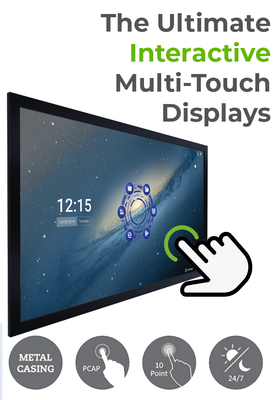
An interactive conference room display has built-in touch functionality, allowing users to annotate, whiteboard and navigate content directly on screen. It is particularly useful for workshops and collaborative sessions.

Anti-glare coating

An anti-glare or matte panel coating reduces reflections from windows, ceiling lights and other bright sources. It is especially helpful in rooms with lots of natural light or strong overhead lighting.

Video conferencing and cameras

Camera and conferencing terms

From all-in-one video bars to dedicated native room systems, these terms explain how participants join calls and how remote attendees see the room.

Huddle room with a video conferencing bar and commercial display

Video bar

A video bar combines a camera, microphones and speakers in one unit mounted above or below the display. It is one of the most common starting points when specifying video conferencing equipment for a small or medium room. Video conferencing bars simplify small and medium meeting rooms because fewer separate components need to be installed and connected.

PTZ camera

PTZ stands for pan, tilt and zoom. A PTZ camera can be moved and zoomed remotely or automatically to follow a speaker or reframe the room. These cameras are most useful in larger boardrooms where a fixed wide-angle camera cannot frame everybody properly.

BYOD

BYOD means Bring Your Own Device. The room’s camera, microphone and speakers connect to a participant’s laptop, usually by USB or wireless connection, instead of the room using its own dedicated computer.

BYOM

BYOM means Bring Your Own Meeting. A participant’s laptop still runs the call, but content, audio and camera connectivity are simplified through one cable or a wireless connection. BYOM works well for businesses using several meeting platforms.

Native room system

A native room system, such as a Microsoft Teams Room or Zoom Room, has its own dedicated compute device and joins meetings without requiring somebody to connect a laptop. For a practical next step, see our Microsoft Teams Room setup guide. Native systems provide a consistent one-touch experience but normally require platform-specific licensing.

Choosing between native and BYOM

Native room systems provide consistency for organisations committed to one platform. BYOM provides more flexibility when users regularly join meetings through Teams, Zoom, Webex and Google Meet.

Meeting room audio

Microphone and sound terminology

Audio quality often has a greater effect on the meeting experience than the screen. A well-planned room considers microphone coverage, speakers, acoustics and processing together. These terms explain how modern systems capture speech, reduce noise and prevent echo.

Premium boardroom with ceiling audio and dual-display AV system

DSP

A Digital Signal Processor manages microphone and speaker audio quality. It can reduce echo, balance volume and suppress background noise. In larger rooms, DSP quality can have more effect on the call experience than the display or camera.

Beamforming microphone

A beamforming microphone uses an array of microphone elements to focus on the active speaker and reduce unwanted noise from elsewhere in the room. Beamforming is commonly built into ceiling microphones and modern video bars.

Ceiling microphone

A ceiling-mounted microphone array can cover a wider area than a table microphone. It is useful in larger rooms and spaces where furniture layouts change frequently. Ceiling height, air-conditioning and nearby lighting should be considered during specification.

Echo cancellation

Echo cancellation prevents remote participants from hearing their own voice repeated back with a delay. It is normally handled by the DSP. Poor echo cancellation is one of the most common causes of complaints about meeting room audio.

Control, connectivity and installation

How meeting room equipment connects

These terms cover the controls people interact with, the infrastructure behind the room and the systems used to share content or route AV signals.

Meeting room booking panel and touch control system

Touch controller

A touch controller is the physical interface used to start meetings, switch inputs and control functions such as volume. A well-designed control panel should allow a first-time user to begin a meeting without training.

AV over IP

AV over IP sends audio and video through standard network infrastructure rather than long dedicated HDMI cables. It is particularly useful across larger buildings and multi-room installations.

HDBaseT

HDBaseT sends HD or 4K video, audio and control signals over one network-style cable across longer distances than HDMI can normally manage. It is often used between a wall-mounted display and equipment stored elsewhere.

Matrix switcher

A matrix switcher routes several video or audio sources to several displays or outputs. It is mainly needed in larger rooms and venues with multiple screens or more complicated source-switching requirements.

Wireless presentation system

A wireless presentation system lets participants share a laptop or phone screen without a cable, usually through a dongle or app. It removes the common meeting-room problem of searching for the correct adaptor.

Room booking panel

A room booking panel is a small display mounted outside a meeting room. It shows availability and syncs with a calendar system. Explore ScreenMoove’s room booking panel solutions for shared office spaces.

Software and platforms

Room software and management terms

The hardware is only one part of a meeting room. Software controls how calls are joined, how devices are managed and how displays can be used outside scheduled meetings. Software controls how calls are joined, how devices are managed and how displays can be used outside scheduled meetings.

Wireless meeting room presentation and collaboration system

Microsoft Teams Rooms

Microsoft Teams Rooms combines a display, camera, microphones, speakers, compute device and touch controller into a certified room experience. Systems are available on Android and Windows hardware.

Zoom Rooms

Zoom Rooms is Zoom’s native meeting room platform. It runs on certified room hardware and provides a consistent one-touch experience for joining Zoom meetings without connecting a laptop.

CMS

A content management system schedules and manages content shown on displays. A meeting room display may use a CMS to show branded information, announcements or wayfinding content when it is not being used for a call.

Firmware and device management

Firmware is the built-in software running the display, camera or room system. Keeping firmware updated helps prevent compatibility and security problems as conferencing platforms release software updates.

Frequently asked questions

Meeting room AV FAQs

What is the difference between BYOD and BYOM?

BYOD means the camera, microphone and speakers connect to a laptop, usually through USB. BYOM still uses a laptop to run the call but simplifies how the laptop connects to the room’s display, camera and audio through one cable or a wireless connection.

Do I need a PTZ camera for a small meeting room?

Usually not. PTZ cameras provide the greatest benefit in larger rooms where a fixed wide-angle lens cannot frame everyone properly. Small and medium rooms are generally well served by a video bar with a wide-angle or auto-framing camera.

Why does my meeting room echo on calls?

Echo is usually caused by audio processing or microphone placement rather than the quality of the speakers. Poor echo cancellation, microphones positioned too close to speakers and rooms with lots of hard surfaces are common causes.

Is 4K necessary for every meeting room?

No. 4K is most useful when people need to read fine details such as spreadsheets, technical drawings or dense slides from a distance. Full HD can still be suitable for straightforward presentations in smaller rooms.

What is the difference between a native room system and BYOM?

A native system has its own dedicated computer and joins meetings directly without a laptop. BYOM relies on a participant’s laptop but makes it easier to connect that laptop to the room’s professional display, camera, microphones and speakers.

Meeting room AV made clearer

Not sure which terms apply to your room?

Speak to ScreenMoove about specifying displays, conferencing hardware, audio and control systems as one project. We will translate the specification into plain English before you buy anything.

Fully equipped corporate meeting room with display, conferencing and wireless presentation system
Previous article AV Installation Compliance
Next article BYOD vs Native Room Systems: Which Is Right for Your Business?