


average order value
Digital Menu Boards for Restaurants: Do They Really Increase Average Order Value?
Published September 18, 2026
Restaurant Digital Signage Guide
Digital Menu Boards for Restaurants: Do They Really Increase Average Order Value?
Digital menu boards can do far more than replace printed menus. Used properly, they can make profitable products more visible, support faster promotions, encourage add-ons and give restaurants much greater control over what customers see at the point of order.
Digital Menu Boards
Restaurant AOV
QSR Digital Signage

The value of a digital menu board comes from what you display, when you display it and how easily the content can influence the ordering decision.
A static menu board tells customers what you sell. A well-planned digital menu board can influence what customers notice, which products they compare and which extras they consider before placing an order.
That distinction matters in restaurants, cafés and quick-service environments where a large number of buying decisions happen in a short period of time. A customer may have only seconds to choose between an individual item, a meal deal, a premium option or an additional drink.
This is why digital menu boards for restaurants are increasingly treated as part of the sales environment rather than simply as electronic price lists.
But buying screens alone does not guarantee higher revenue. The commercial impact depends on menu design, placement, promotions, pricing, dayparting and how well the technology fits the wider hospitality environment.
Start With the Metric
What Does Average Order Value Actually Measure?
Average order value, usually shortened to AOV, measures the average amount spent each time a customer places an order.
AOV Formula
Total Order Revenue ÷ Number of Orders
If a restaurant generates £10,000 from 1,000 transactions, its average order value is £10. Increasing that figure even slightly can become commercially significant when the uplift is repeated across hundreds or thousands of transactions.
AOV is therefore one of the most useful measurements when judging menu-board performance. Instead of asking whether customers simply noticed a promotion, operators can look at whether transaction value changed after a new menu layout, bundle, daypart or promotional strategy was introduced.
Ordering Behaviour
How Digital Menu Boards Influence Ordering Behaviour

The advantage of digital is not simply movement. It is control over visual hierarchy.
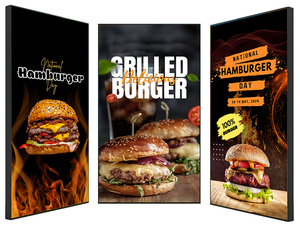
A restaurant can decide which products receive the greatest screen space, which photography appears next to an offer, when a particular promotion becomes visible and how the customer's attention moves from a core product towards a meal, upgrade or add-on.
01
Visual Hierarchy
Give high-priority meals, bundles and promotions more visual prominence than lower-priority information.
02
Sequencing
Present the main purchase first, followed by relevant drinks, sides, desserts or upgrade prompts.
03
Timing
Schedule relevant breakfast, lunch, evening and promotional content rather than showing one menu all day.
The Numbers
The Evidence: Do Digital Menu Boards Increase Sales?

There is evidence that digital menu boards can improve commercial performance, but it is important to separate a useful benchmark from a guaranteed result.
2.5%
AOV uplift
reported in one outdoor digital menu-board pilot analysis.
9.2%
Faster orders
in a study comparing digital and printed drive-through menu boards.
The correct approach is to measure your own baseline and compare revenue, AOV, product mix and promotion performance after implementation. ScreenMoove's digital signage ROI calculator can help model what different levels of uplift could mean financially.
Different Environments
Where Digital Menu Boards Can Move AOV Most
QSR & Takeaway
Strong potential for meal upgrades, sides, drinks and limited-time offers where customers order quickly.
Cafés
Useful for highlighting pastries, larger drinks, flavour additions, lunch bundles and different dayparts.
Casual Dining
Digital displays can support promotions and specials without replacing the entire table-menu experience.

The Upsell Mechanics
Combos, Dayparting and Dynamic Promotional Prompts

The most useful question is not simply, “Can the screen increase sales?” It is, “What exactly are we asking the customer to add or upgrade?”
The Screen Strategy Can Extend Beyond the Menu

Digital signage can also support the customer journey after the order is placed. Order-status screens can separate ordering from collection, reduce repeated questions at the counter and make it clearer when food is ready.
Planning the System
What to Look for in a Digital Menu Board Setup

Good content needs appropriate hardware behind it. A restaurant system should be designed around viewing distance, ambient light, operating hours, mounting position and how frequently content needs to change.
Think About the Customer Before They Reach the Counter

Menu communication does not necessarily have to begin above the till. Window displays, entrance screens and promotional signage can introduce products or offers before the customer reaches the ordering point.
Digital Menu Board FAQs
Do digital menu boards actually increase sales?
They can. Digital menu boards make it easier to promote profitable products, meal deals, upgrades and limited-time offers at the point where customers are deciding what to buy.
How much can a digital menu board increase order value?
There is no universal percentage. One outdoor digital menu-board analysis reported a 2.5% increase in average order value at pilot drive-through locations.
Are digital menu boards worth it for small restaurants?
They can be, particularly where menus change regularly or there are clear opportunities to promote meal deals, drinks, sides and seasonal products.
Can digital menu boards show different menus at different times of day?
Yes. With a suitable content management system, restaurant menu screens can be scheduled to switch automatically between breakfast, lunch, evening or promotional content.
Planning a Restaurant Menu Board Setup?
ScreenMoove can help specify the commercial displays, mounting, content delivery and installation required for a restaurant, café, takeaway or multi-site QSR digital signage project.
Restaurant Digital Signage
Planning New Menu Boards?
ScreenMoove can help specify displays, mounting, installation and digital signage for restaurants, cafés and QSR environments.
View Menu Boards


