


Blog post
A Restaurant Menu Board Success Story That Sells
The lunchtime queue was moving, but not quickly enough. Customers were pausing to read a crowded printed menu, staff were answering the same questions about meal deals, and a changed-out item still appeared on one board. This is where a restaurant menu board success story begins: not with a screen on a wall, but with a clearer route from customer choice to completed order.
For restaurants, cafés, takeaways and food halls, a digital menu board is a sales and operations tool. It can make best-selling items easier to spot, promote higher-margin add-ons at the right moment, and remove the cost and delay of reprinting menus. The strongest results come when the display, content and installation are planned as one commercial system.
What makes a restaurant menu board success story credible?
A good menu board project should solve a defined problem. Perhaps a quick-service restaurant needs to reduce bottlenecks at peak times. A takeaway may need to switch breakfast, lunch and evening menus without sending staff up a ladder. A multi-site operator may want every branch to display the same price change at the same time.
The measure of success depends on that starting point. Faster ordering, improved attachment rates on sides and drinks, fewer pricing errors, reduced print spend and better visibility for promotions are all realistic outcomes. It is less useful to claim that a screen alone will transform revenue. Food quality, service speed, location, pricing and demand still matter. Digital signage improves how clearly the offer is presented and how quickly the business can react.
Consider a representative counter-service site with a large menu, frequent stock changes and a busy weekday lunch period. Its printed boards had been amended with stickers and temporary inserts. The visual hierarchy had disappeared: customers could see every item, but could not immediately see what to choose.
The project team replaced the inconsistent layout with a digital menu board network built around clear menu categories, large prices and high-quality food imagery used selectively. Meal deals were given a dedicated area, while drinks and sides appeared beside the main decision points rather than as an afterthought. When a popular item ran out, the manager removed it from the schedule immediately. When lunch began, the screen changed automatically.
The result was not simply a more modern-looking counter. Staff spent less time explaining the menu, promotional content became consistent, and the business had a practical way to test which messages earned a place on screen. That is the commercial value buyers should look for.
Start with the customer journey, not the screen size
The most common menu board mistake is selecting displays before understanding the viewing environment. A 43-inch commercial display can work well above a compact counter. It may be completely unsuitable for a wide ordering area where customers stand several metres back or where several screens need to carry a full menu.
Map the journey first. Where does a customer enter? Where do they join the queue? How long do they have to read the menu before ordering? Are they looking up at screens, across a counter, or through a shopfront window? These details determine screen quantity, orientation, mounting height and content layout.
For a compact café, one or two landscape screens may be enough to show a concise offer. A busy takeaway with an extensive range may need a row of synchronised displays, separating core products, deals and collection information. Restaurants with self-service kiosks can use menu boards to support the ordering flow rather than duplicate every choice available on the kiosk.
Viewing distance is central. Small text that looks acceptable on a laptop or design proof will fail at the back of a queue. Keep primary choices, prices and calls to action large enough to be read at a glance. If every product needs a paragraph of description, the menu probably needs simplifying before it reaches the screen.
Build content for fast decisions
A digital menu board has more space than a printed card in one sense, but attention is still limited. Customers want confidence, not a moving catalogue of every possible option.
The most effective layouts establish a clear order of importance. First, show the categories or hero products that drive the majority of orders. Next, make prices and meal combinations easy to compare. Then give supporting space to upgrades, limited-time offers and dietary information. Motion can draw attention to a new deal, but constant animation makes prices harder to read and can create visual noise.
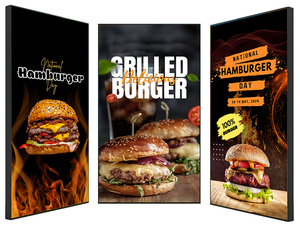
Photography should earn its place. A strong image of a signature burger, pizza or dessert can increase appetite and direct attention to a premium product. Filling every panel with images can make the board harder to scan. The same is true of colour: brand colours should guide the eye, while sufficient contrast keeps menu text readable under bright restaurant lighting.
Content scheduling is where digital boards move beyond print. Breakfast menus can switch to lunch at a set time. A Friday promotion can appear automatically across selected sites. Screens can change before a local event, school holiday or evening service. The rule is simple: schedule only what the operation can deliver consistently. Promoting an offer that staff cannot fulfil is worse than showing no offer at all.
Specify commercial hardware for the actual environment
Consumer televisions are tempting because the upfront price looks lower. In a food-service environment, that saving can disappear quickly. Consumer sets are not designed for long daily operating hours, repeated content playback, commercial mounting or the heat and grease often found near open kitchens.
Commercial digital signage displays are built for the job. Depending on the model and location, buyers can specify longer operating hours, stronger warranties, portrait or landscape operation, integrated system-on-chip playback, and professional mounting compatibility. For sites with central content management requirements, a dedicated media player may be the better choice, especially where network control, reliable scheduling and a consistent multi-screen layout are required.
Brightness needs careful consideration. An internal restaurant with controlled lighting may be well served by a standard commercial display. A menu board facing a bright shopfront, or a display visible from the pavement, needs substantially higher brightness to remain legible in daylight. Buying too dim is a false economy. Buying more brightness than the location needs may add unnecessary cost and energy use.
Placement also matters. Displays should sit clear of excessive heat, steam and grease wherever possible, with suitable ventilation and secure professional mounts. Power, data and cable routing need to be decided before installation day. A clean, reliable installation supports the brand just as much as the content on screen.
Make updates an operational habit
The best hardware cannot compensate for poor ownership. Someone needs responsibility for prices, offers, daypart schedules and approval of new artwork. In a single site, that may be the owner or general manager. In a growing group, central marketing may control brand templates while local managers receive permission to make stock-related changes.
A cloud-based content management system gives operators a practical way to publish updates without visiting every site. That brings speed, but it also needs governance. Use approved templates, set review dates for promotions and make sure branches know which content is live. A stale Christmas campaign in February is highly visible proof that the process has broken down.
For multi-site restaurant groups, establish a simple content calendar covering national campaigns, local promotions, pricing windows and seasonal menu changes. Keep emergency messages ready too. If a site must direct customers to a different collection point, reduce its menu temporarily or highlight a service disruption, the board can become a useful communication channel.
Measure what changes after installation
A menu board project should have a baseline. Before installation, record the practical issues the business wants to improve: average queue time at key periods, print and replacement costs, staff questions, sales mix, or the uptake of meal deals and add-ons.
After launch, give the system time to settle, then compare like-for-like trading periods. Watch for changes in the products featured on screen, but also listen to staff. If customers are still asking where to find a category, the board may need clearer signposting. If a deal performs well but creates pressure at the counter, the offer or its timing may need adjustment.
Testing is valuable when it is controlled. Change one element at a time, such as the prominence of a side dish, the placement of a meal deal or the image used for a premium item. A monthly review is usually more useful than constant redesign. It creates enough time to spot a pattern while keeping the content commercially current.
The practical lesson for restaurant operators
A successful menu board does not need to be flashy. It needs to be legible, accurate, easy to manage and specified for the environment in which it will work. Screen Moove supports restaurant operators with commercial display options, media players, digital signage software, installation planning and technical guidance, so the system can be matched to the site rather than forced into a standard package.
Start with the point where customers hesitate, staff repeat themselves or printed menus become difficult to control. That is often the clearest place to build a menu board that earns its space every trading day.


