


Blog post
Top Displays for Retail Promotions That Sell
A promotion can be brilliant on paper and still disappear in a busy store. The top displays for retail promotions make an offer visible at the right point in the customer journey: from the pavement outside to the aisle, queue line and till. The right format does more than play content. It gives pricing, product launches and time-sensitive campaigns the presence needed to influence a purchase.
For UK retailers, the decision should start with the selling environment rather than screen size alone. Ambient light, viewing distance, available floor space, campaign frequency and the need to manage several locations all affect which commercial display will deliver value. Consumer televisions may appear cost-effective initially, but they are rarely designed for long operating hours, portrait installation, remote content management or the sustained brightness required in retail.
Top displays for retail promotions by location
High-brightness window displays
A storefront screen has one job before any other: stop people walking past. High-brightness digital signage displays are the strongest choice for shop windows exposed to daylight, where a standard indoor screen can look grey, washed out or reflective. Brightness is measured in nits, and this specification matters far more in a sun-facing window than it does on an internal wall.
For many window campaigns, a commercial display in the 2,500 to 4,000 nit range provides the visibility required in bright conditions. The exact level depends on glass position, direction of sunlight and whether the display sits behind the glass or within a more protected frontage. A north-facing shopping-centre unit has very different demands from a street-facing window receiving afternoon sun.
Window displays work particularly well for seasonal offers, new arrivals, property listings, beauty promotions and high-margin product launches. Portrait orientation is often the practical choice because it suits narrow windows and social-style creative, although landscape can be more effective for wide promotional video. An integrated media player or separate signage player makes scheduled content changes straightforward, allowing a breakfast offer, lunchtime campaign and evening message to run automatically.
Freestanding digital totems
Where there is no useful wall space, a freestanding digital totem creates its own promotional position. These displays are suited to store entrances, concessions, shopping-centre walkways and larger sales floors where customers need directing towards a campaign, collection or service desk.
A totem earns its place when it is doing more than repeating a poster. It can promote a limited-time bundle, display a QR code for loyalty sign-up, show a product video or point shoppers towards stock located elsewhere in the store. Double-sided formats are especially valuable in open spaces because they communicate with customers moving in either direction.
Placement needs discipline. A screen placed in a narrow route can obstruct accessibility and become visual background noise. Position it where customers naturally pause or make decisions, such as just inside the entrance, beside an escalator or near a promotion zone. For unattended public-facing installations, choose a commercial enclosure and base designed for stability and cable management rather than adapting a domestic TV stand.
Shelf-edge and aisle-end screens
Retail promotions often succeed or fail at the point of choice. Smaller commercial displays at aisle ends, on promotional gondolas or near product categories can connect the message directly to the item being sold. They are well suited to cross-selling: coffee machines with compatible pods, trainers with care products, or a meal deal with relevant add-ons.
The trade-off is content discipline. Small screens cannot carry a crowded campaign with paragraphs of copy, multiple prices and dense imagery. One product, one customer benefit and one clear price or action will normally outperform an over-designed slide. Use motion sparingly too. If every display in a store is moving at once, the overall effect can feel distracting rather than premium.
Digital menu boards and queue displays
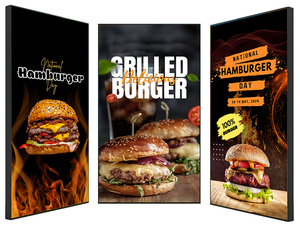
For food retail, cafés, takeaway counters and concession units, digital menu boards are promotional infrastructure rather than decorative screens. They allow teams to feature meal deals, upsell extras, remove unavailable products and adjust messages by time of day without replacing printed panels.
A menu board needs clear hierarchy first and promotional impact second. Core items and prices should remain easy to read from the expected queue distance, while campaign space can highlight higher-margin combinations, limited editions or collection offers. Multiple synchronised displays are useful where menus are broad, but a video wall is not automatically the answer. Separate commercial screens are often simpler to update and can give more flexibility when the menu changes.
Video walls for major campaigns
A video wall provides scale where a single screen would lack impact. Retailers use them in flagship stores, department-store departments, showrooms and experiential zones to build excitement around launches, premium ranges and brand storytelling. The visual result is striking, particularly when ultra-narrow-bezel displays are paired with content designed for the full canvas.
This is not the right solution for every promotion. Video walls require suitable viewing distance, planned wall structure, power and data provision, professional installation and content that respects the panel joins. A large wall playing standard 16:9 video with no creative planning can look underused. Where space is limited, one larger-format commercial display may provide a cleaner and more cost-effective result.
Interactive touchscreens and kiosks
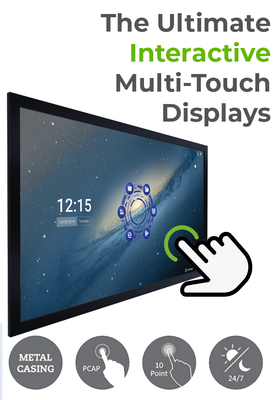
Interactive displays are valuable when customers need help narrowing a choice rather than simply seeing an offer. In fashion, automotive, home improvement, travel and technology retail, a touchscreen can compare products, locate stock, collect customer details or show a wider catalogue than the shop floor can hold.
Promotional content should be part of the customer journey, not a barrier to it. A kiosk that opens with a clear “Find your product” route and then presents relevant offers feels useful. One that forces visitors through a long campaign before they can access information will be ignored. Consider cleaning requirements, accessibility, screen height, network security and the support process before deploying interactive hardware at scale.
How to choose commercial retail promotion displays
The strongest specification is the one that matches the site. Start with operating hours. A screen that runs from opening until close every day needs commercial-grade components and a warranty aligned with that usage. Retailers operating extended hours, transport-linked sites or convenience formats may need displays rated for 24/7 operation.
Then assess light and location. Indoor displays commonly work well for aisle, menu and wall applications, while window-facing screens need much higher brightness and often a thermal plan to manage heat behind glass. Do not judge a display solely in a showroom or office environment. Ask how it will look at noon on a clear day, with reflections from the pavement and competing visual noise around it.
Screen size should follow viewing distance and the amount of information required. A 43-inch display may be ideal for a compact promotional bay, whereas a 55-inch or 65-inch screen can be appropriate at an entrance or across a wider sales area. Bigger is not automatically better if customers stand close to the content or if the screen overwhelms the fixture it is meant to support.
Portrait capability is another practical consideration. Many retail campaigns are designed for vertical mobile-first creative, and portrait screens can make better use of tall fixtures and windows. Check that the display is rated for portrait operation. Rotating a screen not designed for it can affect heat management, warranty coverage and long-term reliability.
Finally, plan the content system before ordering hardware. A central digital signage CMS allows authorised teams to schedule offers, update pricing, monitor players and keep multi-site campaigns consistent. For one store, a simple managed player may be enough. For a national estate, remote control, user permissions, proof-of-play reporting and templates can reduce the workload significantly.
Build the campaign around the customer’s next move
The best retail display is not necessarily the brightest, largest or most expensive. It is the one that puts a relevant message where a customer can act on it. A window screen should generate a visit. An entrance totem should direct attention. A shelf-side display should make the product easier to choose. A menu board should make ordering faster while improving spend per transaction.
That is why display planning should involve operations, marketing and IT from the start. Marketing owns the message, but operations knows where queues form and which areas are congested. IT needs confidence in connectivity, media players and support arrangements. A specialist commercial AV partner can help align the hardware, mounting, installation and signage software around those realities.
Screen Moove supports retail teams with commercial display hardware, digital signage software, installation and technical guidance for campaigns ranging from a single promotional screen to a managed multi-site rollout. The useful next step is to map the customer route through your store, identify the one decision each screen needs to influence, then specify the display around that purpose.


