



Blog post
How to Measure Digital Signage ROI Properly
A screen that looks impressive but cannot be tied to a commercial outcome is difficult to justify at budget review. Digital signage ROI is not simply the value of content shown on screen versus the price of the display. It is the measurable return created when the right commercial hardware, placement, software and content work together.
For a restaurant, that return may be larger average order values and fewer menu reprints. For a retailer, it could be more footfall from the high street or stronger uptake of promoted lines. In a school, office or healthcare setting, the gain is often time saved distributing vital information, better communication compliance or fewer avoidable enquiries. The calculation starts with a clear business purpose, not a screen size.
What should digital signage ROI include?
The basic calculation is familiar:
ROI = (financial gain - total investment) / total investment x 100
The challenge is defining both sides honestly. A £1,500 screen installation is not a £1,500 investment if it also requires a media player, CMS licence, installation, content design, network preparation and staff time. Equally, the return is not limited to direct sales. Commercial displays can reduce operational costs, replace printed materials and help teams act on information more quickly.
A useful approach is to separate value into three categories: revenue generated, cost removed and risk reduced. Revenue generated is usually easiest to identify in retail, hospitality and leisure. Cost removed matters heavily for multi-site businesses that regularly print posters, menus, price cards or internal notices. Risk reduced can be relevant where rapidly updating safety messages, waiting-time information or compliance communications prevents disruption.
Do not claim every possible benefit in the business case. Choose the outcomes the organisation can reasonably measure, then set a baseline before deployment.
Start with the job the screen needs to do
Digital signage delivers better returns when each display has one primary role. A shop window screen is there to stop passers-by and bring them inside. A digital menu board should make ordering easier while directing customers towards profitable upgrades. A reception display may reduce repetitive visitor questions, promote services and reinforce a professional first impression.
Trying to make one screen serve every purpose often weakens the content and measurement. If a reception display rotates through ten messages, it may still be useful, but it becomes harder to establish which message changed behaviour. Prioritise the action that matters most, such as scanning a QR code, choosing a meal deal, booking a meeting room or visiting a particular department.
Placement is part of the commercial decision. A high-brightness window display may cost more than a standard indoor screen, but a lower-specification display facing daylight can be unreadable for much of the day. In that case, the cheaper purchase is likely to produce the poorer return. The same principle applies to screen orientation, viewing distance, operating hours and whether the display is touched frequently.
Match hardware to the environment
Consumer televisions can appear attractive on an initial quote, particularly for a small rollout. However, they are rarely designed for prolonged daily use, centralised management, portrait operation or demanding public environments. Premature replacement, image retention, poor brightness and limited warranty cover can quickly undermine the expected saving.
Commercial-grade digital signage displays are specified around operating hours, brightness, panel reliability and installation requirements. For a 24/7 site, transport hub, takeaway counter or busy retail environment, those specifications are directly connected to uptime. A blank screen during peak trading does not only look unprofessional - it removes the opportunity the display was installed to create.
Set baselines before installation
The most credible ROI reports compare performance before and after the signage goes live. That means recording the current position in advance. A restaurant can capture sales volumes and margin for promoted items. A retailer can compare footfall, conversion and sales for a product category. A facilities team can count printing costs, support tickets or recurring visitor queries.
Where possible, use a control. If one of six branches receives new digital menu boards first, compare its results against the other sites over the same period. If a screen advertises a limited offer, run the promotion at consistent times and compare sales to a previous equivalent period. Seasonal conditions, weather, local events and staffing can all affect results, so avoid treating a single busy week as proof.
For multi-site networks, standardise the data collection method. One site reporting gross sales, another reporting units sold and a third reporting anecdotal feedback will not produce a reliable view. A central CMS can help by confirming exactly when content was scheduled and on which screens, allowing trading or operational data to be reviewed against actual screen activity.
The metrics that matter by application
A few focused measures are more useful than a crowded dashboard. The right metrics depend on the deployment.
Retail and window displays
For retail, look at passing footfall, store entries, conversion rate, promoted-product sales and average transaction value. A window-facing display may be measured through door-counter data and time-based comparisons. If the aim is to clear stock, track units sold and margin rather than just impressions.
QR codes can provide a useful secondary signal, but scans alone are not revenue. Give each campaign or location a distinct code so the result is attributable, then assess whether visitors complete the intended action.
Restaurants, cafés and takeaway businesses
Digital menu board ROI can come from reduced print changes, faster promotion updates, increased sales of high-margin items and fewer ordering delays. Track the mix of items sold, add-ons per transaction and average spend before and after content changes.
The screen design matters as much as the display. A crowded menu that is difficult to read can slow the queue. Clear price hierarchy, legible type, sensible dwell time and well-timed daypart menus are what turn a menu board into a sales and service tool.
Offices, education and public-facing venues
These environments often need a broader calculation. Measure printing and distribution costs, time spent issuing updates, attendance at internal events, meeting room utilisation or reductions in routine enquiries. Short staff and visitor surveys can add context, but they should support rather than replace operational data.
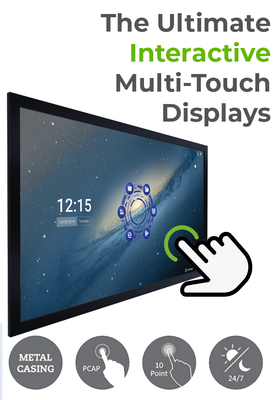
An interactive touchscreen may justify its cost through self-service. If it helps visitors find a room, check in, view an event programme or access forms without staff intervention, estimate the number of assisted interactions avoided and apply a realistic time value. Be conservative: saved minutes only count as financial benefit where that capacity can be used productively.
Account for the full cost of ownership
A sound business case includes more than the invoice total. Include display hardware, mounts or enclosures, players, software, installation, electrical and data work, content production, ongoing licences and support. Where screens replace existing equipment, include disposal and downtime planning if applicable.
Then consider lifecycle. A commercial display that operates reliably for years may have a higher upfront price but a lower annual cost than a cheaper alternative that needs replacing sooner. Energy use also matters for larger networks and long operating hours. Power scheduling, automatic brightness controls and sensible on/off times can reduce avoidable running costs without limiting campaign effectiveness.
It is also sensible to put a value on management time. A signage network that requires someone to visit each branch with a USB stick creates a recurring cost and risks inconsistent messaging. Central content scheduling can reduce that burden, especially where offers, menus or corporate communications change frequently.
Improve returns after launch
ROI should not be treated as a one-off calculation made six months after installation. The first content plan is a starting point. Review performance regularly, then change one variable at a time: the promotion, content timing, creative, call to action or screen location. This makes it easier to see what is genuinely improving the result.
Content should also respect the viewing context. A customer walking past a storefront has seconds to understand a message. Someone waiting in a reception area has longer and may respond to more detailed information. The display network should support local relevance while retaining brand consistency across sites.
Technical monitoring protects value too. Check that displays are online, media players are operating, scheduled content is current and brightness remains appropriate. A managed system with dependable installation and support reduces the risk that a small technical issue becomes weeks of lost screen time. Screen Moove can support businesses that need the hardware, software, installation and technical guidance considered as one commercial deployment rather than separate purchases.
The strongest digital signage investment is rarely the one with the most screens. It is the one where every screen has a defined job, an appropriate specification and a number the business can improve over time.


