



Blog post
iiyama Professional Displays Review: Business Fit
A screen in a reception, shop window or classroom is only valuable when it remains clear, controllable and dependable through the working day. This iiyama professional displays review looks at where the brand fits in a commercial AV specification, from standard digital signage to interactive touchscreens and meeting room displays.
For many UK organisations, iiyama occupies a useful position between consumer television and premium enterprise display ranges. Its professional portfolio is broad enough to support straightforward single-screen installations, interactive education projects and multi-site communication networks without adding unnecessary complexity. The right choice, however, depends on the environment, operating hours, viewing distance and how the content will be managed.
iiyama professional displays review: the commercial position
iiyama is well known in the professional monitor and touchscreen market, with a display range that suits education, corporate, retail, hospitality and public-facing environments. Its strength is practical specification: familiar screen sizes, commercial connectivity, touch technology where required, and models designed for longer operating hours than a domestic TV.
That matters when a display is expected to run menus, internal communications, wayfinding or promotional content for much of the day. Consumer televisions can appear cost-effective at purchase, but they are not always built for sustained use, portrait mounting, remote management or the warranty expectations of a business installation. A commercial display should be selected around its actual duty cycle rather than its headline price.
iiyama’s ProLite ranges commonly cover three distinct needs. Digital signage displays are suited to messaging and promotional content. Interactive touch displays support teaching, presentations and self-service applications. Desktop and professional monitors suit control rooms, meeting spaces and staff workstations. This makes the brand particularly relevant where a project combines different screen types under one procurement plan.
The trade-off is that iiyama may not be the first choice for every highly specialised brief. A sun-facing retail window may require a dedicated high-brightness display with a substantially higher nit rating. A large video wall, outdoor installation or advanced corporate estate may benefit from a platform with more extensive central device management. For standard indoor use, though, iiyama often provides a strong balance of commercial features and budget control.
Image quality, brightness and screen orientation
Resolution is rarely the deciding factor on its own. Most current professional displays offer 4K resolution at the larger sizes commonly used in signage, meeting rooms and interactive applications. That is more than sufficient for crisp menu layouts, product imagery, dashboards and presentation material when content has been designed correctly.
Brightness deserves closer attention. In a meeting room with controlled lighting, a standard commercial brightness level can perform well. In a brightly lit foyer or a shop near large windows, the same panel can look muted at certain times of day. Buyers should assess ambient light at the intended mounting location, not just the room generally. Direct light on the screen, reflective flooring and glazed entrances can all reduce perceived image quality.
Most indoor commercial displays work well in landscape or portrait orientation, subject to the individual model specification. Portrait screens are particularly effective for retail campaigns, directory boards and narrow wall spaces, while landscape remains the natural format for menu boards, presentations and reception information. Orientation should be decided before purchase because ventilation, mounting points and content layout must all match the final installation.
For digital menu boards, screen size and viewing distance are equally important. A 43-inch display may be appropriate above a compact counter, while 55-inch or larger screens can improve legibility in wider restaurant and takeaway settings. The useful test is simple: can a customer read the smallest price and allergen information from where they order? If not, a higher-resolution panel will not solve a poor layout or undersized screen.
Reliability for digital signage and daily business use
The main reason to specify a professional display is continuity. Commercial panels are intended for repeated daily use and generally provide more suitable warranties, connections and mounting flexibility than domestic alternatives. Nevertheless, operating-hour ratings vary between models. A screen rated for extended daily operation is not automatically a 24/7 panel, so this must be checked where screens will remain active overnight or support round-the-clock sites.
Heat management also affects lifespan. Displays enclosed in joinery, placed above cooking equipment or installed in unventilated wall recesses can operate hotter than intended. A well-specified screen can still fail early if its installation does not allow airflow or if the power supply is poorly protected. This is particularly relevant to hospitality venues, gyms and retail sites where the screen location is chosen for visibility rather than service access.
For organisations with several locations, consistency has real operational value. Choosing a repeatable display range simplifies mounting, replacement planning and content templates. It also helps facilities and IT teams keep a sensible stock of compatible brackets, cables and media players. The best screen is not always the most feature-rich option - it is often the one that can be deployed, supported and replaced predictably across the estate.
Touchscreen options for education and self-service
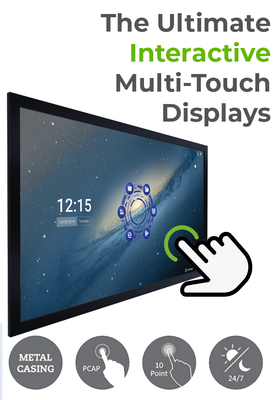
iiyama is especially established in touch technology. Its interactive displays are relevant for classrooms, training rooms, meeting spaces, kiosks and collaborative work areas. The experience depends on the touch method, surface finish, operating system or connected PC, and the applications being used.
In education, a large interactive display can replace a projector and whiteboard combination while providing a brighter image and direct annotation. Schools and colleges should consider screen size against room depth, as well as speaker performance, front-facing ports and the practical position of wall controls. A 65-inch screen can suit smaller teaching rooms, while 75-inch and 86-inch formats are usually better for larger groups.
In corporate settings, interactive screens work best when they support familiar meeting workflows. Staff need to connect laptops quickly, share content at the right resolution and use video conferencing hardware without a complicated sequence of adapters. If a room already has a dedicated conferencing system, check USB touch pass-through, camera compatibility and available HDMI or USB-C connections before finalising the display.
For public-facing self-service, touch is only one part of the specification. The kiosk enclosure, glass protection, accessibility height, PC or player, network connection and software interface are all equally important. A responsive panel cannot compensate for an interface with small buttons, unclear directions or an unreliable connection to a booking or ordering system.
Connectivity, players and content management
Professional displays need to fit the wider AV system. HDMI remains essential for many installations, but USB-C, DisplayPort, USB touch connections, LAN control and serial control can be significant depending on the project. Corporate rooms may benefit from USB-C connectivity that carries video, data and charging through one cable. Signage installations often require a reliable HDMI input from an external media player and a scheduled on/off routine.
Some displays include built-in playback or smart functionality, but an external digital signage player is often the better long-term choice for business networks. It separates the screen from the content platform, gives more consistent remote management and makes future upgrades easier. This is useful for menu boards, retail promotions and internal communications where centrally scheduled content is required.
Before ordering, confirm how the display will receive content, who will update it and what happens if the network drops. A basic USB playback solution can be suitable for static information at one site. A multi-site organisation usually needs cloud-based content management, user permissions, scheduling and proof that every screen is online and playing the correct campaign.
Where iiyama displays make the most sense
An iiyama professional display is a sensible fit for indoor business environments where dependable everyday performance, touch capability or flexible AV connectivity matters more than specialist extremes. Retailers can use standard commercial panels for promotions and product information. Restaurants can build clear menu board layouts around appropriately sized landscape displays. Offices can combine meeting room screens with interactive collaboration panels. Education providers can standardise classrooms around interactive displays that support teaching software and connected devices.
The brand is less likely to be the complete answer where the screen must fight direct sunlight, operate outdoors without a protective enclosure, form a fine-pitch LED display, or create a large-format video wall with narrow bezels and advanced calibration. Those requirements call for a more specialised product category and a full site assessment.
For a straightforward commercial AV project, Screen Moove can help match iiyama displays with the correct mounting, media player, signage software and installation approach. The useful next step is to define the screen location, content source, daily operating hours and audience viewing distance before comparing panel specifications. That turns a display purchase into a system that staff can run confidently and customers can actually see.


