
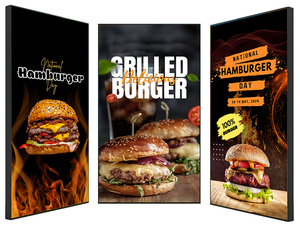


 Restaurant menu screens can be scheduled, updated remotely and adapted for breakfast, lunch, dinner and seasonal promotions.
Menus are one of the most frequently changed parts of a restaurant, yet many businesses still rely on printed boards that become outdated as soon as prices, products or service times change.
Digital menu display screens give restaurants, cafés and quick-service venues a more flexible way to present products and promotions. This guide explains how digital menu boards work, how they compare with printed menus and what to consider before choosing a screen, mount, content platform or installation partner.
What This Guide Covers
What Is a Digital Menu Board?
A digital menu board is a commercial display used to show restaurant menu content such as products, prices, meal deals, images, allergen notices and promotional messages. It normally replaces a printed board, lightbox or laminated menu positioned above a counter or within the customer ordering area.
Although it uses digital signage technology, a restaurant menu screen has specific requirements. The display format must suit the available wall or counter space, the content needs to remain readable from the expected viewing distance and updates often happen more frequently than they would on a general promotional screen.
Designed for extended daily use and professional installation.
Built around clear categories, prices, imagery and promotions.
Content can be changed without reprinting or replacing boards.
How Digital Menu Boards Work
Most systems combine a commercial screen, a media player or built-in operating system, a content management platform and an internet or local network connection.

1. Create the menu content
Designs are produced using templates or bespoke branded layouts.
2. Upload and schedule it
A menu board content management platform controls what appears and when.
3. Publish to one or more screens
The same content can be sent to a single restaurant or managed consistently across multiple locations.
Scheduling is particularly useful for dayparting. A venue can show breakfast items in the morning, switch to lunch offers automatically and then display an evening menu without staff changing the screen manually.
Digital Menu Board vs Printed Menu
Printed menus can still be appropriate for tables, compact counters and venues with very stable products. Digital screens become more useful when prices, promotions, availability or service periods change regularly.
| Consideration | Printed menu | Digital menu board |
|---|---|---|
| Price changes | Requires editing and reprinting | Can be updated remotely |
| Dayparting | Boards must be swapped manually | Menus can change on a schedule |
| Visual content | Static imagery and text | Images, motion and rotating promotions |
| Multi-site control | Each site needs updated print materials | Content can be centrally managed |
Screen Formats for Restaurant Menus
The right format depends on the width of the service area, the amount of information on the menu and how customers move through the venue.
A practical option above smaller counters where the full menu can fit on one display.
Useful in narrow spaces, queue lanes or beside ordering points.
Separates categories across two or more displays and gives larger menus more room.
Creates a larger visual canvas for flagship venues and high-impact concepts.
For larger installations, video wall menu displays can combine multiple narrow-bezel panels into one coordinated layout.

Choosing the Right Size and Brightness
A screen should be large enough for customers to read the smallest important text from their normal position in the queue. The viewing distance, mounting height, number of menu categories and available wall width all affect the correct size.

Questions to ask
- How far away will customers stand?
- Will one screen hold the whole menu clearly?
- Is the display close to a bright shopfront window?
- Does the screen need to operate all day?
- Will the menu be landscape or portrait?
Standard indoor commercial displays suit many counter-service environments. Where sunlight or strong ambient light reaches the screen, high brightness displays for shopfronts may provide better visibility.
Mounting and Installation Considerations
Menu boards are commonly wall-mounted or suspended from the ceiling above a service counter. The installation must keep screens secure, level and correctly angled while allowing enough airflow and access for maintenance.

Check ceiling height, wall strength, customer sightlines and working space behind the counter.
Power, network and media connections should be routed safely and kept visually tidy.
Multi-screen rows need consistent spacing, height and tilt to look professional.
Choose purpose-built menu board mounting systems and consider professional digital signage installation services for multi-screen, high-level or complex projects.
Menu Content and Design
The screen hardware only works well when the content is easy to scan. Customers should be able to identify categories, compare products and understand prices without reading dense blocks of text.

- Use clear category headings and consistent spacing.
- Keep prices visually connected to the correct product.
- Limit animation so it supports rather than distracts.
- Use high-quality food imagery selectively.
- Build layouts that work across every screen size.
Templates can work well for straightforward menus, while a professional menu board design service can help larger brands create a consistent visual system across several screens and locations.
What Digital Menu Boards Cost
The total project cost depends on more than the screen. A realistic budget should include the display, mounting hardware, media player or software, content design, cabling and installation.
Screen size, brightness, operating hours and brand all affect price.
Single-screen wall mounts cost less than aligned multi-screen systems.
Cloud management may involve a licence or subscription.
Access, cabling, wall type and working height influence labour requirements.
Because product and installation pricing can change, use the current digital menu board product range or request a tailored quote rather than relying on a fixed guide price.
Is a Digital Menu Board Right for Your Restaurant?
A digital menu board is most valuable when it solves an operational or customer communication problem rather than simply replacing print for its own sake.
It may be a good fit when you:
- change prices, products or promotions regularly;
- serve different menus at different times of day;
- operate several restaurants and need consistent content;
- want to promote meal deals, add-ons or seasonal items;
- need a clearer menu layout above a busy counter.
For broader restaurant, hotel and venue applications, explore ScreenMoove's guide to digital signage for hospitality.


