


Blog post
Touchscreen Kiosk Benefits for UK Businesses
A lunchtime queue should not depend on whether one member of staff can step away from the counter. Nor should a visitor have to wait for reception to find a room, print a pass or point them in the right direction. Touchscreen kiosk benefits are most visible at these pressure points: they give customers and visitors a clear route to take action while staff remain available for the work that needs a person.
For UK organisations, a commercial touchscreen kiosk is not simply a large tablet on a stand. It is a customer-facing service point built for regular public use, often connected to payment systems, booking platforms, wayfinding content, stock information or a digital signage network. The right deployment can speed up transactions, improve consistency and provide useful operational insight. The wrong deployment can create another queue, so specification and user journey matter.
The touchscreen kiosk benefits that affect daily operations
The strongest case for a kiosk is usually practical rather than technical. It removes small, repeatable tasks from busy teams and lets people complete them at their own pace.
Shorter queues at peak times
In quick-service restaurants, cafés, leisure venues and retail environments, self-service ordering can increase the number of customers served when demand rises. Customers can browse a menu, review modifiers and submit an order without holding up the main till. A well-designed interface can also prompt relevant add-ons, such as a side dish, drink or upgrade, at the point of decision.
This does not mean kiosks should replace every staffed position. Some customers prefer to speak to a member of the team, and complex orders or accessibility requirements may need personal support. The practical model is often a blended one: kiosks handle straightforward transactions, while staff focus on exceptions, hospitality and fulfilment.
More consistent information and service
A touchscreen kiosk presents the same approved information every time. That is valuable wherever accuracy matters. A visitor management kiosk can issue the correct instructions for contractors and guests. A retail product finder can show the current range, sizes and available options. A hospital or council building can direct visitors to the correct department without relying on a busy reception desk.
For multi-site operators, centrally managed content helps maintain brand consistency across locations. Price changes, seasonal campaigns, health and safety notices, maps and promotions can be updated in a controlled way rather than relying on printed material being replaced locally.
Better use of staff time
Reception, front-of-house and shop-floor teams frequently answer the same questions: Where is the meeting room? Which floor is this department on? Can I check in here? What is available in this size? A kiosk can handle these repetitive requests around the clock, leaving employees more time for advice, problem-solving and customer care.
The benefit is particularly relevant in environments with variable footfall. A hotel may have a rush of arrivals in the early evening. A college may experience heavy movement between lessons. A corporate office may receive visitors in concentrated bursts before meetings. A kiosk provides extra capacity without requiring another fixed staff member at the desk for every peak period.
Stronger customer engagement at the point of choice
Interactive content asks for participation rather than passive viewing. In retail, customers can compare products, explore colours, locate stock or browse extended ranges that are not on the shop floor. In showrooms, a kiosk can support product configuration and lead capture. In hospitality, it can promote venue information, events and local services.
This interaction needs a clear purpose. A touchscreen placed in a public area with no obvious task will often be ignored. The best installations begin with a single, visible instruction such as “Order here”, “Find your room”, “Check in” or “Browse the range”.
Touchscreen kiosk benefits by setting
A kiosk programme should reflect the environment, audience and task rather than follow a one-size-fits-all specification.
Restaurants, takeaways and food service
Self-order kiosks can make menus easier to browse, reduce perceived waiting times and keep ordering consistent during busy periods. They are especially useful for operators with detailed menus, customisation options or promotions that change regularly. Integration with the EPOS platform and kitchen workflow is essential. Without it, a fast customer ordering process can simply move the bottleneck behind the counter.
Retail and showroom spaces
Retail kiosks work well as product finders, endless-aisle browsing tools, loyalty sign-up points and consultation displays. They can help customers locate items in larger stores and give staff a useful reference point during a sale. For window-facing or brightly lit areas, display brightness and anti-glare performance deserve close attention. A standard indoor screen may look acceptable in a dim showroom but become difficult to read near strong daylight.
Offices, education and public buildings
In corporate settings, kiosks commonly support visitor check-in, badge printing, meeting room wayfinding and internal communications. Schools and colleges can use them for campus maps, event information and student services. Public-facing organisations may require multilingual journeys, accessible positioning and clear privacy controls when personal details are entered.
Choosing commercial hardware, not consumer equipment
The enclosure and screen are part of the service experience. A consumer tablet may suit a short-term demonstration, but it is rarely the right choice for a public, high-use installation. Commercial touchscreen kiosks are designed around longer operating hours, more durable components, secure mounting and professional connectivity.
Screen size should follow the task. A compact display can be effective for check-in or ticket collection, while product browsing, wayfinding and ordering normally benefit from a larger format. Floorstanding units offer strong visibility in open spaces, whereas wall-mounted kiosks can save room in narrow reception areas. Countertop units may suit lower-footfall service desks.
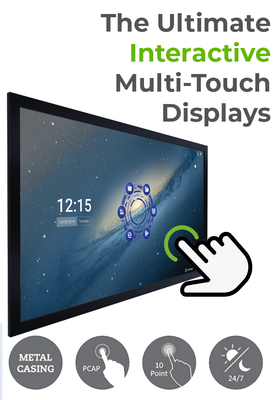
Specify the touch technology for the expected usage. Projected capacitive touch provides a familiar, responsive experience for most indoor applications. In tougher or outdoor-adjacent locations, protective glass, an appropriate enclosure rating and temperature management may matter more than the interface alone. If the kiosk is installed in a publicly accessible area, consider tamper resistance, cable management and a secure lockable housing from the outset.
Connectivity also needs planning. A kiosk may need Wi-Fi or wired network access, power provision, a media player, printer, barcode scanner, payment terminal, camera or ID reader. Each peripheral adds value only when it supports the intended journey. Procurement teams should confirm compatibility before hardware is ordered, particularly where payment, visitor management or third-party software is involved.
Design the journey before ordering the screen
Many kiosk projects fail because hardware is chosen first and the user journey is considered later. Start by defining the most common action a person needs to complete, how long it should take, and what happens if they cannot complete it alone.
Keep the interface focused. Large touch targets, readable text, a limited number of choices per screen and clear confirmation messages reduce hesitation. Avoid making customers enter information that the business does not genuinely need. For payment or personal data, give users enough physical privacy and ensure the software processes information in line with applicable UK data protection requirements.
Accessibility should be built into both the placement and content. Consider reach height for wheelchair users, contrast for readability, language choices, audio requirements and whether a nearby staff member can assist. There is no single perfect mounting height for every use case, but a kiosk that excludes part of its audience creates avoidable friction.
Measuring whether a kiosk is working
A successful kiosk should be judged against a business outcome, not just screen uptime. Restaurants may track order volume, average order value and queue times. Retailers may assess product searches, assisted sales and lead captures. Offices can review visitor processing times and reception workload.
Use the data to improve the service. If users abandon the journey at a particular step, the interface may be unclear or the request may be too demanding. If staff are still repeatedly answering the same question, the kiosk content may need a clearer entry point. Content, software and hardware should be reviewed as one system.
For organisations planning a customer-facing deployment, Screen Moove can support the practical decisions around display format, commercial hardware, installation and the wider digital signage setup. The priority is not adding a screen for its own sake. It is creating a reliable self-service point that makes the next customer, visitor or colleague interaction easier.


