


Blog post
Wayfinding Displays That Keep Visitors Moving
A visitor standing at a reception desk, a customer searching for collections on another floor, or a patient trying to find an outpatient department all have the same immediate need: a clear next step. Wayfinding displays turn that moment of uncertainty into useful direction, helping people move through a building without repeatedly asking staff for help.
For businesses and public-facing organisations, this is more than a convenience. Poor navigation creates queues, late appointments, missed opportunities and a weaker first impression. The right commercial display solution can combine live directions, service updates, advertising and emergency messaging on one managed screen network.
What are wayfinding displays?
Wayfinding displays are digital screens used to guide people through a physical environment. They can show a site map, room directory, floor plan, route instructions, waiting-time information or directions to key facilities such as lifts, toilets, exits and reception points.
They are commonly installed in office receptions, hospitals, schools, colleges, retail centres, hotels, leisure venues, transport settings and large hospitality sites. Their role changes with the setting. A corporate office may need to direct visitors to meeting rooms, while a shopping centre needs to promote stores and guide customers to amenities at the same time.
Unlike static printed signs, digital wayfinding can be changed quickly. This matters when room bookings move, departments relocate, access routes close or a venue is running a temporary event. Content can be scheduled by time of day, updated from a central platform and adapted across multiple locations.
Start with the visitor journey, not the screen size
The best system starts by identifying where people lose their way. A large display in the wrong location will not solve a navigation problem. Walk the site as a first-time visitor would, from car park or entrance through reception and on to the final destination.
Look closely at decision points. These are the places where visitors must choose a direction: a main entrance, a lift lobby, a junction between corridors, a staircase or the entrance to a separate department. Displays placed at these points should give direct, concise guidance. They should not force people to study a detailed map while others are passing behind them.
Reception areas often benefit from a directory or welcome screen, while junctions need simple directional content. Near individual rooms, a smaller screen may display occupancy, booking details or local instructions. In large buildings, a combination of fixed digital signage and interactive touchscreens usually provides the most effective coverage.
It also helps to consider the audience. Staff who use a building every day need different information from occasional visitors. In healthcare, directions should be reassuring and easy to understand under pressure. In education, content may need to support students, parents and contractors during busy arrival periods. In retail, the system should guide customers without distracting from the purchase journey.
Choosing the right display format
There is no single best screen for wayfinding. The format should follow the location, viewing distance, available space and type of information being presented.
Wall-mounted directory screens
Wall-mounted commercial displays are a practical choice for receptions, corridors and lift lobbies. They can present directories, maps and dynamic announcements in portrait or landscape orientation. Portrait screens work particularly well for tall directories and floor-by-floor listings, while landscape formats suit maps and split-screen content.
A 43 to 55-inch display is often appropriate for a standard reception or corridor, but larger areas may require 65-inch or 75-inch screens. Do not select by size alone. Text must remain readable from the expected viewing distance, particularly for visitors who are standing several metres away.
Freestanding digital totems
Freestanding digital totems give greater flexibility where wall space is limited or where a screen needs to be seen from several approaches. They are well suited to hotel lobbies, shopping environments, public foyers, sports centres and large corporate entrances.
Totems can make a strong visual statement, but they need careful positioning. Avoid placing them where they obstruct pedestrian flow, create a bottleneck or compete with reception furniture. A double-sided configuration can be useful in open-plan areas where visitors approach from both directions.
Interactive wayfinding kiosks
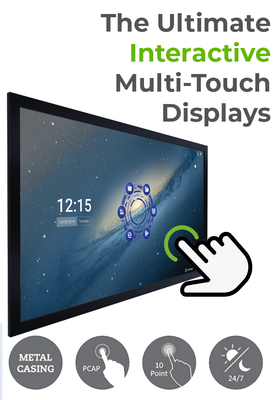
Touchscreen kiosks are the strongest option when visitors need to search rather than simply follow a route. A user can look up a person, department, shop, classroom or service, then view a route or supporting information. For multi-tenant offices, healthcare facilities and campuses, this can reduce the administrative burden on front-of-house teams.
Interactive content needs disciplined design. The most popular tasks should be obvious on the home screen, the buttons need to be large enough for comfortable use, and the route back to the start must be clear. A kiosk with too many menu layers can be slower than a printed directory.
High-brightness and outdoor screens
Wayfinding near glazing, entrances or external routes has a different technical requirement. Standard indoor screens can look washed out in strong daylight, even if the content design is good. High-brightness commercial displays are designed for these locations, offering the visibility needed for window-facing or sunlit areas.
For fully outdoor installations, use an enclosure and display system rated for the environment. Weather protection, operating temperature, cable routes, anti-glare performance and mounting security all need to be considered at specification stage. Outdoor wayfinding is a specialist deployment, not simply an indoor screen placed under a canopy.
Readability is a commercial requirement
Wayfinding fails when people cannot absorb the information in a few seconds. The content should prioritise destination, direction and distance. Use familiar terms, consistent naming and plain language. If the building calls an area “Level 2” on one screen and “Second Floor” on another, visitors will hesitate.
High contrast is essential. Dark text on a light background or light text on a dark background can both work, provided the contrast is strong and the brand palette does not reduce legibility. Avoid placing important text over busy photography or video. Movement should support attention, not make directions harder to read.
Typography needs to suit the viewing distance. Small type may look refined on a designer’s monitor but become unusable on a 55-inch screen across a lobby. Maps should also be simplified for screen use. Show landmarks, key routes and a clear “you are here” position rather than trying to reproduce every architectural detail.
Accessibility should be part of the brief from the outset. This includes readable fonts, suitable contrast, clear icons, sensible screen heights and content that does not rely on colour alone. Where a venue has multilingual audiences, consider language options or internationally recognised symbols. The right approach depends on the setting and the people who use it.
Build a network that staff can manage
A screen network only remains useful if it can keep up with the building. Digital signage software allows teams to update directions, schedule content and control multiple displays from one place. For a multi-site business, central management is often the deciding factor between a consistent customer experience and a patchwork of out-of-date screens.
Plan content ownership before installation. Reception may control visitor messaging, facilities may manage closures and route changes, marketing may use selected areas for promotions, and IT may oversee network access and device security. Clear permissions prevent both delays and accidental changes.
Commercial-grade screens and media players are preferable to consumer televisions for a permanent wayfinding role. They are built for longer operating hours, portrait installation where required, remote management and consistent performance. Consider the operating schedule, warranty, panel brightness, built-in system-on-chip capability and whether a separate signage player is needed.
Connectivity also deserves attention. Wired network connections are usually the most dependable for fixed screens, while Wi-Fi may be suitable where cabling is impractical. In either case, allow for secure network configuration, remote support and a contingency plan if a device loses connection.
When wayfinding should also sell, inform and protect
A wayfinding display does not need to show directions every second of the day. In quieter periods, it can carry brand messaging, promotions, event schedules, visitor guidance or local service information. This makes better use of the investment, especially in retail, hospitality and leisure environments.
The balance matters. Navigation content should always take priority at key decision points. A visitor should never have to wait through an advert to find the route to a meeting room or clinical department. Use schedules and screen zones intelligently, reserving clear directional information for the moments it is most needed.
The same network can also support operational communications. Emergency instructions, temporary closures, queue information and service changes can be deployed quickly when the system, content templates and approval process are already in place.
Plan installation around the real environment
A professional survey identifies issues that are easy to miss during product selection: power availability, network points, wall construction, viewing angles, ambient light, cable containment and compliance requirements. It also confirms that mounts, totems and kiosks are safely specified for public use.
For larger projects, installation should be coordinated with content design and software setup. A screen switched on without approved layouts, location data or trained users is not a finished wayfinding solution. Screen Moove supports commercial display projects with hardware supply, signage software, installation and technical guidance, helping businesses specify a system that fits both the site and the team running it.
The most effective wayfinding begins with one practical question: what does a person need to know at this exact point in their journey? Answer that clearly, present it on dependable commercial hardware, and your displays will keep visitors moving with confidence.


