


Blog post
What Is a Commercial Display for Business Use?
A reception screen that goes black during opening hours, a menu board with faded colours, or a shop-window TV that cannot be read in daylight all create the same problem: the display was not built for the job. So, what is a commercial display? It is a professional-grade screen designed to run reliably in business environments, often for long hours, with the brightness, connectivity, warranty and control features that public-facing use demands.
Commercial displays are used wherever information, promotions, wayfinding or video need to be seen clearly and managed consistently. That could mean a single meeting room screen, a row of digital menu boards, an interactive touchscreen in a school, or a nationwide retail signage network.
What is a commercial display and how is it different?
A commercial display is purpose-built for professional installation and ongoing operation. Unlike a domestic television, it is specified around operating hours, image quality in challenging lighting, installation orientation, remote management and long-term availability.
The difference matters because a consumer TV is generally intended for a few hours of viewing each day in a living room. A commercial screen may be required to operate 16, 18 or 24 hours a day, fitted in portrait orientation, connected to a media player, and mounted where staff cannot easily reach it. It must continue presenting a consistent image without distracting menus, unwanted updates or consumer features getting in the way.
Commercial displays are also supplied with business use in mind. They commonly include a manufacturer warranty appropriate for commercial settings, serial and network control options, and models that remain available for longer periods. That makes it easier for multi-site organisations to standardise their hardware and replace a unit without changing the look or technical setup of an entire estate.
The specification features that matter
Not every commercial screen needs the highest specification. A staff meeting room and a sun-facing shop window have very different requirements. The right choice begins with the environment, the content and the planned hours of use.
Operating hours and panel reliability
Operating-hour ratings are one of the clearest distinctions between commercial and domestic screens. Displays are often rated for 16/7, 18/7 or 24/7 operation. The first figure refers to the number of hours per day and the second to days per week.
For a café menu board that runs from breakfast to late evening, a 16/7 or 18/7 display may be suitable. For transport information, hotel reception signage, control rooms or round-the-clock advertising, a 24/7 model is usually the better investment. Selecting a lower-rated screen to reduce the initial cost can be a false economy if it fails early or falls outside its warranty conditions.
Brightness for the installation location
Brightness is measured in nits, also called cd/m². Standard indoor commercial displays are commonly around 350 to 500 nits, which works well in offices, classrooms, restaurants and many retail spaces.
Brightly lit areas require more output. A screen positioned behind a shop window may need 700, 1,500, 2,500 nits or more, depending on daylight, glass reflections and whether the display faces direct sun. Outdoor digital signage needs a weather-rated enclosure or purpose-built outdoor display, high brightness, temperature management and suitable ingress protection. A screen that looks excellent in a showroom can become unreadable once installed in a glazed storefront, so site conditions should guide the specification.
Orientation, bezels and image quality
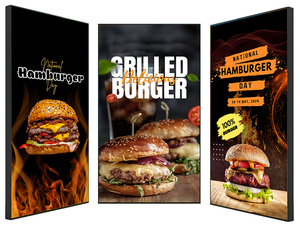
Commercial displays are designed to operate in landscape, portrait or sometimes face-up orientation. Portrait installation is common for retail promotions, wayfinding and digital posters. It should never be assumed that a consumer television can safely operate this way, as heat dissipation and panel construction may not support it.
For video walls, narrow bezels are essential. The smaller the gap between panels, the more convincing the large-format image becomes. Video wall displays also provide the calibration and control features required to keep content aligned across multiple screens.
Resolution is another consideration. Full HD remains effective for many individual menu boards and digital posters, particularly at typical viewing distances. 4K is increasingly preferred for larger displays, close-up viewing, detailed product content and corporate presentation screens. Higher resolution does not solve poor content design, though. Text still needs to be sized for the distance at which customers will read it.
Connectivity and control
Professional displays are designed to work with commercial AV systems. Depending on the model, this may include HDMI, DisplayPort, USB, LAN, Wi-Fi, RS232 and network-based control. These connections allow a display to work with digital signage players, conferencing equipment, video wall controllers and central management platforms.
Many commercial screens include a system-on-chip player. This can run compatible signage software directly on the display, reducing the number of external devices behind the screen. It is a tidy option for straightforward digital signage, but an external player may be more appropriate where content is complex, security requirements are stricter or a business needs a particular CMS platform. The best route depends on the network rather than a single feature on a specification sheet.
Where commercial displays are used
The category covers far more than wall-mounted screens. In retail, commercial displays support window advertising, promotional messaging, product launches and queue-busting information. High-brightness models make campaigns visible from the pavement, while indoor screens can change offers by time of day or location.
Restaurants, cafés and takeaway businesses use digital menu boards to update prices, promote meal deals and keep menus consistent across sites. The screen must remain readable from a distance, handle the required daily operating hours and be positioned to avoid glare from lighting or windows.
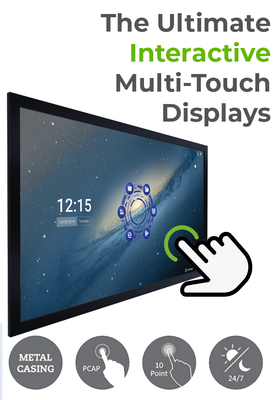
In education, interactive flat-panel displays support teaching, collaboration and presentations. These differ from standard signage displays because touch accuracy, writing experience, front-facing ports and classroom software compatibility become central to the decision.
Corporate environments often need meeting room displays, video conferencing hardware and reception signage. Here, the practical questions include room size, camera placement, Microsoft Teams or Zoom compatibility, cable management and whether users can start a meeting without IT support.
Healthcare, leisure, hospitality and public-sector sites may need a mixture of wayfinding screens, digital noticeboards, touchscreen kiosks and information displays. For multi-site deployments, central content control is often as important as the physical screen itself.
Choosing the right commercial display
A good buying decision starts with the business outcome, not the screen size. Ask what the display needs to achieve: attract passers-by, shorten perceived waiting times, improve internal communication, support a lesson, guide visitors or provide a better meeting experience.
Then assess viewing distance and available space. A 43-inch screen can be effective for close-range information, while a large reception area, classroom or conference room may need 65 inches, 75 inches, 86 inches or more. Mounting height matters just as much. A well-specified screen installed too high or at the wrong angle will still be difficult to read.
Content should shape the hardware choice. Static messages and simple scheduled images place different demands on a network than video, live data, interactive content or multiple zones on screen. A digital signage CMS enables teams to schedule material, assign content by location and update screens remotely. This avoids relying on USB sticks or site visits every time a price, event or campaign changes.
Installation deserves equal attention. The correct commercial mount must support the screen’s VESA pattern and weight, while allowing enough ventilation for safe operation. For window displays, ceiling-hung double-sided screens, totems and video walls, cabling, structural support, access for maintenance and power provision should be planned before equipment arrives.
Why consumer TVs can create avoidable risk
A consumer TV may appear cheaper at first, particularly for a small project. For low-use, private viewing, that can be perfectly reasonable. In a business setting, however, the risks quickly become more expensive than the saving.
Consumer models may have restricted operating hours, unsuitable warranties, lower brightness, limited portrait support and fewer remote-control options. Their styling can also be less appropriate for professional installation, with logos, stands and ports designed for a domestic setup rather than a clean wall, ceiling or kiosk installation.
There are exceptions. A back-office screen used occasionally for internal announcements does not always require a premium 24/7 commercial panel. The key is to match the product to the use case rather than treating every screen as interchangeable.
Building a display solution that lasts
The strongest commercial display projects consider the full system: display, mounting, player or built-in software, network access, content, installation and support. Leaving any one of these until the end can cause delays, compatibility issues or a screen that is technically installed but rarely updated.
Screen Moove helps UK organisations specify complete commercial display solutions, from a single business screen to coordinated digital signage, interactive and video wall projects. The practical next step is to define where the screen will sit, how long it will run, who needs to manage the content and what visitors must be able to see or do. Those answers turn a display purchase into a dependable business tool.


