


Advertising Displays
Best Indoor Digital Display Screens: 2026 UK Buyer's Guide
Published September 24, 2026
2026 UK Buyer's Guide
Best Indoor Digital Display Screens: 2026 UK Buyer's Guide
Compare indoor commercial screens for shops, offices, gyms, restaurants and reception areas — including brightness, screen size, advertising use, wall mounting and content management.
Indoor Digital Signage
Advertising Displays
Commercial Displays

The right indoor display depends on where it is installed, what people need to read and how the content will be managed.
The screen on the wall may be one of the first things your customer sees — but choosing an indoor digital display involves more than finding the biggest screen that fits the space.
Retailers, gyms, restaurants, offices, reception areas and hospitality businesses increasingly use displays for promotions, menus, internal communications, wayfinding and customer information. The correct hardware depends on operating hours, ambient light, viewing distance, orientation, content and installation.
A commercial display is also different from simply mounting a domestic television and connecting a USB drive. Professional screens are designed around business requirements such as longer duty cycles, portrait installation, mounting compatibility and centralised content management.
This guide compares some of the best options by use case and explains the practical decisions to make before ordering. You can also browse ScreenMoove's full range of commercial digital signage displays.
Commercial Hardware
What Makes an Indoor Digital Display Screen Commercial-Grade?

Commercial display screens are designed for environments where screens form part of the day-to-day operation of the business. Depending on the model, that can mean extended operating schedules such as 16/7 or 24/7, business-focused warranties and hardware designed around permanent installation.
01
Duty Cycle
Commercial screens can be specified for long operating periods where displays run throughout the working day.
02
Orientation
Many professional displays support landscape or portrait mounting for menus, promotions and wayfinding.
03
Content Playback
USB playback, integrated operating systems and CMS compatibility can remove the need for a dedicated PC.
Brightness is another major specification. It is normally measured in cd/m², sometimes referred to as nits. A screen that performs well deep inside an office may not have enough brightness for a brightly lit retail environment near glazing.
Before choosing a standard television instead, read more about the difference between commercial and consumer TVs.
Best by Use Case
The Best Indoor Digital Display Screens by Use Case
There is no single indoor display that is best for every application. A screen for a reception desk has different requirements from a display near a shopfront window or a multi-site retail deployment.
Best All-Rounder for Retail and Hospitality — Moove 55" Commercial Monitor
A 55-inch screen is a useful middle ground for many indoor signage projects. It provides a substantial visual area without immediately moving into oversized large-format display territory.
The current Moove 55" commercial monitor is designed for 24/7 commercial operation, offers 4K UHD resolution and supports portrait or landscape installation. It is well suited to shops, restaurants, offices, reception spaces and general business signage.
Best Compact Screen for Counters, Receptions and Waiting Areas — Moove 43"

For smaller commercial spaces, 43 inches can provide a better balance between visibility and available wall area. It works particularly well behind counters, in reception areas, waiting spaces, small cafés and retail departments where customers are relatively close to the display.
The Moove 43" commercial monitor is a 4K commercial signage display designed for 24/7 operation and landscape or portrait installation. Smaller 32-inch screens and larger 50-inch options can be considered where the available space or viewing distance changes.
Best for Bright Interiors and Near Glazing — Moove 43" High Brightness
Ambient light can wash out a conventional screen. This becomes particularly important in retail units, cafés, reception spaces and commercial interiors close to windows.
The Moove 43" 700 cd/m² high brightness display combines 700 cd/m² brightness with Android 14, 4K UHD resolution and 24/7 commercial operation. It is particularly relevant where a standard indoor screen struggles against higher ambient light.
Best Premium Brand Options — Samsung and LG Commercial Displays
Larger estates and organisations standardising hardware across many locations may prefer established manufacturer ecosystems. ScreenMoove supplies ranges from major commercial display brands including Samsung commercial displays and LG.
Best When Wall Space Is Limited — Freestanding Digital Posters
Not every project needs to be wall mounted. Freestanding digital posters can provide a strong alternative for entrances, showrooms, shopping centres, hospitality spaces and temporary campaigns where drilling into the wall is undesirable.
Not Sure Which Size or Brightness You Need?
Send ScreenMoove details of your space, viewing distance and intended content and our team can help identify the most suitable screen specification.
Talk to a Display Specialist
Advertising Screens
Choosing a Digital Display Screen for Advertising

A digital display screen for advertising should be specified around the environment rather than the advert alone. Brightness, orientation and viewing distance determine whether customers can comfortably see and understand the message.
For conventional indoor environments away from direct daylight, commercial displays around the 350–500 cd/m² range are commonly suitable. Brighter interiors and areas close to glazing can benefit from displays around 700 cd/m² or higher. A screen intended to face directly through a shop window is a more specialised application, where purpose-built high brightness window displays should be considered.
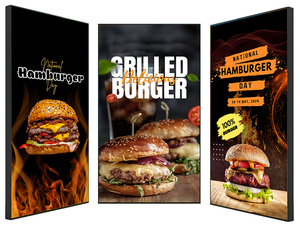
Orientation also changes how advertising content is perceived. Portrait displays resemble traditional printed posters and are effective for fashion imagery, product promotions, wayfinding and full-height creative. Landscape screens work naturally for video, menus, dashboards and content containing several information zones.
Content management matters just as much as the panel. One screen may be easy to update manually, but updating ten, fifty or hundreds of screens individually quickly becomes inefficient.
A cloud digital signage software platform can centralise content, scheduling and screen management. Campaigns can then change by location, time of day or audience without visiting each display.
Retailers planning larger projects can also explore ScreenMoove's guide to digital signage for retail shops.
Installation Planning
Wall Mounted Digital Display Screens: What to Know Before You Drill

A professional installation should look as though the screen belongs in the room rather than being added afterwards. That starts with choosing the correct bracket and planning power, data connections and cable routes before installation.
Check both the weight of the display and its VESA mounting pattern. VESA defines the spacing of the mounting points on the back of the screen, so a bracket must support both the required pattern and total load.
Before Ordering
✓ Confirm display weight and VESA pattern.
✓ Decide between fixed, tilt or other mounting configurations.
✓ Confirm whether portrait orientation is required.
✓ Plan power and network points before fixing the screen.
✓ Allow suitable access for maintenance and future replacement.
If you already know the display model, ScreenMoove's free screen mount compatibility checker can help identify suitable mounting options.
You can also browse digital signage wall mount brackets for commercial installations.
Quick Specification Guide
Indoor Display Size and Brightness Quick Guide

There is no universal screen-size formula. Viewing distance, content density, mounting position and room layout all matter. The ranges below are broad planning guidance rather than fixed rules.
| Setting | Typical Size Range | Brightness Guidance | Orientation |
|---|---|---|---|
| Counter / Till | 32–43" | Standard indoor | Portrait or landscape |
| Reception | 43–65" | 350–500 cd/m² | Either |
| Gym Floor | 43–75" | 350–700 cd/m² | Usually landscape |
| Restaurant Menu Wall | 43–55" per screen | 350–500 cd/m² | Usually landscape |
| Shopping Centre Unit | 43–75" | 500–700+ cd/m² | Either |
| Atrium / Near Glazing | 55–98"+ | 700 cd/m²+ | Project dependent |
For more options, explore ScreenMoove's range of digital indoor displays.
Project Delivery
Installation and Ongoing Support
A single smaller display mounted at accessible height can be relatively straightforward. Larger screens, multiple-display installations, high-level mounting, portrait runs and ceiling-mounted installations require more planning.
The display position should be considered alongside power, network access, mounting structure, cable management and future maintenance. For multi-screen projects, consistency between display height, spacing and content can make a significant difference to the finished result.
ScreenMoove also provides professional digital signage installation for projects where specialist mounting and AV support are required.
Indoor Digital Display Screen FAQs
Can I use a normal TV as an indoor digital display screen?
A consumer TV can display content, but commercial screens are designed around business requirements such as longer operating schedules, portrait installation, professional control and commercial warranties.
How bright should an indoor digital display screen be?
Standard indoor environments may suit roughly 350–500 cd/m², while brighter spaces or areas close to glazing can benefit from around 700 cd/m² or more. Direct window applications usually require specialist high-brightness displays.
What size digital display screen do I need for advertising?
Choose screen size according to viewing distance, available wall space and the smallest important text customers must read. Content legibility is more important than simply choosing the largest screen.
Do wall mounted digital display screens need a separate media player?
Not always. Many commercial displays support USB playback or have integrated operating systems. A dedicated player or CMS may be preferable when more advanced scheduling and remote management are required.
How do I update content on multiple indoor screens?
A cloud-based digital signage CMS allows multiple connected displays to be updated remotely, with different content and schedules assigned by screen, location or group.
Find the Right Indoor Display for Your Space
ScreenMoove can help specify screen size, brightness, orientation, mounting and digital signage software for retail, hospitality, gyms, offices, education and other commercial environments.
Continue Reading
Related Digital Signage Guides
Indoor Digital Signage
Need Help Choosing a Screen?
ScreenMoove can help with display size, brightness, mounting, CMS software and professional installation.
Talk to Our AV TeamJump to a Section
At a Glance
General indoor signage:
350–500 cd/m²
350–500 cd/m²
Bright interiors:
Around 700 cd/m²+
Around 700 cd/m²+
Poster advertising:
Portrait orientation
Portrait orientation
Menus & video:
Often landscape
Often landscape
Multiple locations:
Consider cloud CMS
Consider cloud CMS
Shop Indoor Displays
Compare commercial digital signage screens for retail, hospitality, corporate and public environments.
View Displays


