




Blog post
Digital Signage for Healthcare That Works
A missed clinic appointment is rarely just an empty slot. It can mean a patient who arrived at the wrong department, a reception team answering the same question for the twentieth time, and a waiting area that feels uncertain rather than well managed. Digital signage for healthcare gives hospitals, GP practices, dental surgeries and care settings a practical way to improve these moments at scale.
The right screen network does more than play a welcome message. It directs people through complex buildings, communicates delays with sensitivity, promotes services and delivers timely information to staff. To achieve that, the display hardware, mounting, content software and installation need to be specified for the environment rather than chosen as an afterthought.
Where Digital Signage for Healthcare Delivers Value
Healthcare estates are busy, varied and often difficult to navigate. A patient may need to find radiology, outpatient clinics, pharmacy or a blood test unit while under stress, dealing with mobility issues or visiting a site for the first time. Static posters can help, but they are difficult to update and quickly become visual background.
Commercial displays provide a central communication channel that can change throughout the day. In reception areas, screens can show arrival instructions, department locations, QR codes for check-in services and health campaign messaging. Near consultation rooms, they can display clear queue information without calling out personal details. In corridors and lifts, they can reinforce routes, visiting guidance and safety notices.
Waiting-room communication is another strong use case. A well-planned programme can explain expected waiting times, promote vaccination or screening services, share wellbeing information and introduce local support resources. The balance matters. Content should be calm, legible and useful, not a fast-moving stream of promotions that adds to the noise of a clinical setting.
Staff-facing signage also has a role, particularly in larger hospitals, clinics and care organisations. Back-of-house screens can communicate shift notices, operational alerts, training reminders, staff recognition and internal campaigns. For multi-site organisations, centrally managed content makes it easier to keep messages consistent while still allowing local teams to publish relevant updates.
Start With the Patient Journey, Not the Screen Size
The most successful projects begin by mapping where people hesitate, queue or need reassurance. This identifies the locations where a display will remove friction rather than simply occupy a wall.
At an entrance, a high-brightness screen may be needed if daylight is strong. At a reception desk, a portrait display or freestanding digital totem can provide a clear directory without taking up counter space. In a long corridor, several smaller displays may give better wayfinding coverage than one large screen at the far end.
Screen size should be based on viewing distance, available wall space and the amount of information shown at once. A large 55-inch or 65-inch commercial display can work well in a main waiting area, while 32-inch to 43-inch screens may be more appropriate outside consultation zones. The objective is not to install the biggest possible display. It is to make essential information readable from the point where a decision is made.
For locations exposed to daylight, specify brightness carefully. Standard indoor displays may be sufficient for enclosed waiting rooms, but entrance atriums, glazed corridors and window-facing areas can require higher-brightness commercial screens. If the image is washed out by sunlight, even the best content will fail.
Choose Commercial Hardware Built for Daily Use
Consumer televisions are not designed for the operating demands of healthcare environments. They may lack the duty-cycle rating, remote management options, warranty coverage and portrait mounting capability required for a professional network. They can also be difficult to replace consistently when models change.
Commercial digital signage displays are designed for extended operation and installation in public-facing spaces. Depending on the application, key requirements may include 16/7 or 24/7 duty cycles, integrated media players, system-on-chip compatibility, landscape and portrait operation, anti-glare panels and commercial warranties.
Mounting is equally important. A properly specified wall mount protects the display, maintains an appropriate viewing angle and keeps cables controlled. In public areas, secure fixings and tidy cable management support both safety and presentation. Where wall mounting is unsuitable, a freestanding totem, ceiling-mounted display or mobile screen stand may be the better option.
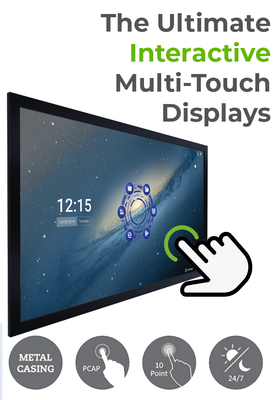
Touchscreen kiosks can be valuable for self-service check-in, directory access and patient feedback, but they require a clear purpose. A touchscreen placed in a busy reception area needs enough space for wheelchair access, a simple interface and a cleaning routine that staff can maintain. For some sites, a non-touch directory screen paired with a QR code is a lower-maintenance alternative.
Content Must Be Clear, Controlled and Accessible
A healthcare screen network is only as useful as the information it displays. Content should use plain English, high-contrast colours, large type and concise calls to action. Avoid placing paragraphs of text on a screen that patients will view for only a few seconds.
Wayfinding content needs particular discipline. Use consistent department names, colour coding and directional symbols across every display and printed sign. If a department is called “Outpatients” on one screen and “Ambulatory Care” on another, visitors will lose confidence quickly.
Accessibility should be part of the brief from the outset. This means readable type, sufficient contrast, careful use of colour and content that does not rely solely on audio. Consider the needs of people with visual impairments, neurodivergent visitors, older patients and those who do not speak English as a first language. Pictograms and short translations can be useful where they genuinely support the local audience.
Content governance also matters. Assign ownership for approvals, scheduling and emergency messages before launch. Clinical teams should not have to chase an external supplier for every minor update, but unrestricted publishing can create inconsistent or inaccurate information. A sensible model gives nominated local users access to approved templates while central communications or facilities teams retain oversight.
Software and Network Management Matter
Digital signage software allows teams to schedule content by site, department, day and time. A main hospital can display different messages in paediatrics, maternity, urgent treatment and staff areas from one central platform. GP groups and care providers can manage multiple locations without sending USB sticks or relying on manual screen updates.
When assessing a content management system, look beyond the template library. Confirm how users publish content, whether screens can be monitored remotely, how quickly urgent messages can be deployed and what happens if an internet connection drops. A reliable player and sensible offline playback options help ensure essential messages remain visible.
Healthcare organisations must also consider security and data protection. Public displays should never expose patient-identifiable information. Queue systems should use numbers or other privacy-conscious identifiers, and software access should be controlled through named user accounts, permissions and secure network practices. IT teams should be involved early where screens connect to an existing network.
Plan Installation Around a Live Environment
Healthcare sites cannot always pause operations while screens are installed. Installation planning should account for patient flow, infection-control procedures, restricted areas, power availability, network access and safe working times. In some settings, work may need to happen outside clinic hours or in short, coordinated phases.
A site survey can identify the practical issues that product specifications alone cannot answer: wall construction, cable routes, Wi-Fi strength, glare, sightlines and accessibility clearances. It is also the point to confirm whether a display needs a recessed installation, protective enclosure or dedicated electrical supply.
For larger roll-outs, standardising screen models, mounts and players simplifies support and future replacement. There can be a case for different screen types in specialist locations, but excessive variation creates avoidable complexity for facilities and IT teams.
A Better Standard for Healthcare Communication
Digital signage should reduce uncertainty, not create another system for staff to manage. Start with the highest-value locations, establish straightforward content rules and choose commercial-grade hardware that suits the operating environment. A phased deployment is often the right approach, particularly when an organisation needs to prove patient-flow benefits before expanding across an estate.
With the right planning, healthcare displays become a dependable part of the building experience: clear when people need direction, reassuring when they need information and flexible when services need to communicate quickly.


